Tracking the Growth of American Authoritarianism

“Can There Really Be Fascist People In A Democracy?”
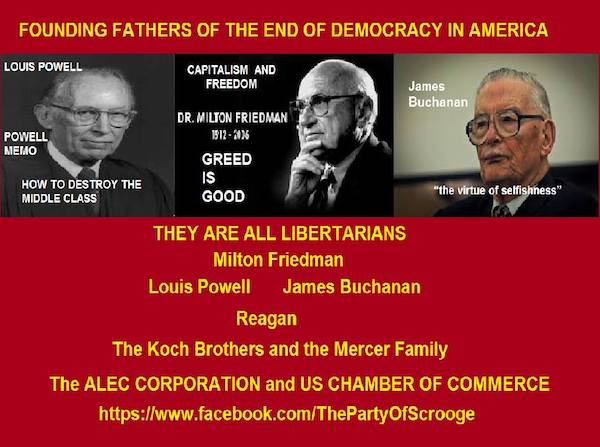
Libertarians are stealthily taking over America.

Since the 1971 Powell Memo, America has moved closer and closer to Fascism.


Moral Values of the Left and Right – History Shows Which Works for All Americans

Throughout this blog, postings have provided details about the strict father and nurturant parent worldviews. Charts in some of those postings show how the dominance of one or the other of these two worldviews affects our economy.

From 1945 to the late 70s, the “We” generation
– Paid their citizenship dues in proportion to their use of national resources that enabled their success,
– Used government to protect and empower citizens and consumers,
– Supported investment in national infrastructure to advance freedom and liberty for all citizens,
– Supported investment in non-profit research for going to the moon, creating the internet, exploring space,

From early 80s to the late 00s, the “Me” generation
– Stopped paying citizenship dues in proportion to their use of national resources that enabled their success,
– Used government to protect and empower corporations and the excessively wealthy,
– Minimized investment in public infrastructure to punish the primary users – the excessively wealthy have private infrastructure,
– Minimized investment in non-profit research,

Here is a side-by-side comparison of the Me and We moral values. Holding either set of values, or a mixture thereof, determines where one stands on topics like the sequester, extending the debt limit, health care, separation of church and state, civil rights, liberty, freedom, race, voter IDs, what to do about unintended pregnancies, public education, public libraries, public roads, public research, public display of religious icons, school prayers, critical thinking, global warming, privatization, public investment, corporate governance, representative governance, success determinants, systemic causation, American exceptionalism, race exceptionalism, gun safety, child safety, prayer in public schools, torture, honor, common good, common wealth, free enterprise, government, non-profit investing, spending, citizenship dues (taxes), etc.

Strict Father “Me” Worldview Nurturant Parent “We” Worldview
Freedom and liberty should be limited only by self-restraint. Freedom and liberty need government-imposed limits that limit the abuse of those who see no need for self-restraint.
Individuals are responsible only for their own well-being and success. Individuals are responsible for both their own well-being and the well-being and success of others.
Severe punishment and “Noble Lies” about threats to individual freedom and liberty are part of the authoritarian arsenal for convincing the masses of what is morally right. Compassion, empathy, and responsibility for all Americans provide for understanding of what is morally right
A strict father enforces a hierarchy of superiority with God at the top, humans over nature, white men over women, children, minorities, and especially poor women, children, and minorities who are poor. Each individual is equally protected from harm and equally empowered for success by other citizens and a representative government.
The strict father will use severe punishment to teach moral values of a social hierarchy. The nurturant parents will teach moral values by caring and showing responsibility for themselves and others.
The social responsibility to provide for the common good is an immoral imposition on individual liberty (greed). Those who benefit more from the common good should pay more to maintain it.
The country is better off if everyone depends totally on personal responsibility. The country is better off when everyone depends on both personal and social responsibility.
Success is due only to self-discipline and if you lack self-discipline you are immoral and deserve your circumstances – you’re on your own. Success is due to self-discipline, innate talent, when you were born, where you were born, what family you were born into, your parent’s choice of friends and religion, your relatives, your teachers, the other kids of your age, your mother’s health care while you were in utero, and other factors and circumstances including the public support of others through their government – we’re all in this together.
Government is bad because it has no self-discipline while free enterprise is a perfect example of self-discipline to enable the success of the individual. Government and free enterprise are as perfect as the citizens or employees who run them and we need both in balance to enable the success of the nation.
Government is necessary for protection only from internal and external threats to freedom and liberty of authority figures (white men). Government must protect and empower its citizens equally to maximize the freedoms and liberties of all citizens including protection from the excesses of free enterprise.
Privatize all non-defense government functions. Liberty is maximal personal responsibility, which requires maximal privatization – and profitization – of all that we do for each other together, jointly as a unified nation – The Public. Any government function which protects and empowers citizens should never be privatized. Privatization creates corporate governance, that is accountable to a small set of key shareholders, and replaces representative governance, that is accountable to voters.

Each worldview makes choices based on their values. Here are some examples of those choices. Which would you chose?

Me: Living life without any restraint, or
We: LIving life with consistent and minimal limitations to protect others from abuse by those who have no self-restraint

Me: Caring only about yourself and those like you, or
We: Caring about all fellow citizens, understanding that life is not fair, and that we must help others.

Me: Believing individual success comes only from strong self-discipline, or
We: Believing individual success comes from both innate talent and many factors beyond individual control.

Me: Lying to promote “Noble” goals is morally justified, or
We: Working together for the benefit of all is morally right.

Me: Promoting inequality based on an arbitrary hierarchy of human attributes, or
We: Promoting equality based on equal protection and empowerment of all citizens regardless of personal differences.

Me: Teaching right from wrong through excessive physical punishment starting in infancy, or
We: Teaching right from wrong by nurturing a responsibility and respect for oneself and others.

Me: Succeeding comes only from self-discipline and individual effort, or
We: Succeeding comes from individual effort that is either enhanced or reduced by factors beyond the control of the individual.

Me: Living under corporate governance which is accountable only to the CEO and a few major stockholders, or
We: Living under representative government that is accountable to voters who .

Me: Maximizing corporate freedom by eliminating citizenship dues (taxes) and governmental checks and balances, or
We: Maximizing citizen freedom by supporting a government that checks and balances abusers of power.

Me: Having corporate governance concerned only about profit at the expense of other stakeholders including customers, or
We: Having representative government concerned exclusively about protecting and empowering all citizens equally.

Me: Having corporate governance that has bought our representative government, or
We: Having representative governance accountable to voters that is independent of large corporations which are financially as large as small countries.

Me: Limiting representative government and privatizing all that is public, or
We: Limiting corporate governance to protect citizen’s well-being, prosperity and safety.

Me: Supporting the individual freedom to sell or own weapons for mass killing, or
We: The social responsibility to prevent gun violence against all of our children.

Here is how George Lakoff summarized these two moral sets of beliefs:

Progressives tend to believe that democracy is based on citizens caring for their fellow citizens through what the government provides for all citizens – public infrastructure, public safety, public education, public health, publicly-sponsored research, public forms of recreation and culture, publicly-guaranteed safety nets for those who need them, and so on. In short, progressives believe that the private depends on the public, that without those public provisions Americans cannot be free to live reasonable lives and to thrive in private business. They believe that those who make more from public provisions should pay more to maintain them.

Ultra-conservatives don’t believe this. They believe that Democracy gives them the liberty to seek their own self-interests by exercising personal responsibility, without having responsibility for anyone else or anyone else having responsibility for them. They take this as a matter of morality. They see the social responsibility to provide for the common good as an immoral imposition on their liberty.

Their moral sense requires that they do all they can to make the government fail in providing for the common good. Their idea of liberty is maximal personal responsibility, which they see as maximal privatization – and profitization – of all that we do for each other together, jointly as a unified nation.

They also believe that if people are hurt by government failure, it is their own fault for being “on the take” instead of providing for themselves. People who depend on public provisions should suffer. They should have [to] rely on themselves alone – learn personal responsibility, just as Romney said in his 47 percent speech. In the long run, they believe, the country will be better off if everyone has to depend on personal responsibility alone.

Moreover, ultra-conservatives do not see all the ways in which they, and other ultra-conservatives, rely all day every day on what other Americans have supplied for them. They actually believe that they built it all by themselves.

On page 14 of The Little Blue Book, George Lakoff said, “The repeated use of conservative or liberal moral language is often the decisive factor in whether an independent uses a liberal or conservative moral system for a given election.”

The “we” moral view held sway after WWII.  We rebuilt Europe, built the interstate highway system, sent men to the moon, and paid down the national debt. The “me” moral view has held sway since the 80’s and we suffered the Great Recession, have saved banks too big to fail or prosecute, and legalized a massive transfer of income and wealth to the ONE% from the working class.

Posted in Authoritarianism, Protect & Empower   |   Leave a comment   |  

Corporate Governance Will Transfer More Wealth If Social Security Is Privatized

(This blog posting comes from portions of Who Stole the American Dream by Hedrick Smith.)

The history of the transition from company funded pensions to employee self-directed 401Ks and the limited success of 401Ks shows vividly that the destruction of Social Security through privatization will only benefit corporations.

In a subsection of chapter 5, The Pivotal Congress – Jimmy Carter and 1977-78 Democrats, Mr. Smith describes how the 401K was “tucked into the omnibus tax bill [as] a small-print provision.” New York representative, Barber Conable, the ranking Republican leader of the House Ways and Means committee, introduced the change. This provision allowed the corporate executives of Kodak and Xerox to hide their profit-sharing bonuses in a tax deferred account. Later in 1981, the Reagan Treasury Department, after “some ingenious prodding from corporate tax consultants,” extended 401K accounts to all workers. This extension, plus changes to the corporate bankruptcy laws that put corporations in charge of their bankruptcies, was the beginning of the end of company funded pensions. (This was also the beginning of the shift away from representative governance to corporate governance as laid out in The Powell Memo.)

In a subsection of chapter 7, The Great Burden Shift – Funding Your Own Safety Net: Crippled by Debt, Mr. Smith adds details concerning the shift from corporate funded pensions to employee funded 401Ks. In 1980, before the extension of 401Ks to all workers by Reagan’s Treasury Dept., corporate pension plans covered 84 percent of employees who would receive retirement benefits for life. By 2006, only 33 percent of employees had a company pension plan. In 2012, that is down to nine percent. Put another way, employees were paying about “11 percent of their retirement costs” in 1950. “By the mid-2000s, they were paying 51 percent.”

Corporations have gained from this transition while employee retirement has dwindled from a near certainty to a small possibility. For those companies that dropped their pension plan totally, they added 6 to 7 percent to their profits. For those who replaced pensions with 401Ks, their profits went up about 4 percent if they matched employee contributions.

Since we have been living with this pro-corporate transition since 1981, what else can we learn about how average workers have suffered and what does this tell us about the losses we should expect from the privatization of Social Security?

To start, 401K participants and assets have mushroomed from 7 million and $92 billion in 1984 to 44 million and $2.2 trillion in 2004. Now there are over 65 million citizens participating with over three trillion dollars in assets, However, this averages out to about $50,000 per participant.


For some understanding of what’s been happening with all the 401K self-directed retirement plans, Hedrick Smith interviewed Brooks Hamilton, a Dallas pension consultant. Mr. Hamilton had reviewed the 401K plans for 15 corporations and their thousands of participating employees. What he found was a part of the growing wealth gap between the really wealthy and everyone else – “a systemic flaw.” Mr. Smith summarized what he learned this way:

The best educated, best paid employees and executives were getting investment returns that were six or seven times greater than the returns of average workers. The gap was compounded year after year. The top brackets were not only able to put away much more money each year, but they got far better returns than rank and file workers …. They didn’t borrow from their 401(k)’s or make [the] mistake of pulling out their retirement fund in one lump sum, triggering a tax penalty. They left the money in and let it grow. They knew how to get the best results and how to avoid costly mistakes.”

Here is a portion of Mr. Smith’s interview with Mr. Hamilton:

HAMILTON: I label this [the] yield disparity. I thought, “We have a yield disparity that is a financial cancer in this, in our great beautiful 401(k) movement.” And I had never seen it before, but it was every where I looked.

SMITH: What do you mean a financial cancer?

HAMILTON: It would destroy the opportunity for ordinary workers to retire in dignity. They can’t get there from here.

Mr. Smith continues, “The 401(k) track record is not good.” As of January 1, 2011, after the Great Recession, “the typical account balance is just $17,686.” For those workers in their sixties, the typical account is worth $84,469. This is just not enough for retirement.

If your annual living expenses were $50,000 and you did not have any Social Security income, then you would need a retirement fund worth $1,250,000 to pay these annual expenses during retirement. That’s almost fifteen times higher than the typical account for someone in their sixties. With Social Security income, the retirement fund could be cut in half. The $84,469 mentioned by Smith would only be enough to cover $3,380, or about seven percent, of those annual expenses in retirement. (This is all based on being able to withdraw only 4 percent of your 401K fund for expenses during each year of retirement.)

Mr. Smith also talked to Jack VanDerhei of the Employee Benefits Research Institute and quoted him as saying, “I would say unless you’re fortunate to be in the upper-income quartiles that you’re probably going to be in for a very rough ride.”

In another interview on the health of the 401Ks Mr. Smith talked with Alicia Munnell of the Center for Retirement Research at Boston College. Ms. Munnell told him:

They [retirees] are not going to be penniless because they have Social Security [for now]. But it’s a very serious situation. Middle-class people are going to be very hard-pressed. People will feel destitute, absolutely forced to cut expenditures, maybe forced to sell their homes, forced to dramatically change their lifestyle. Making ends meet is going to be a consuming task. It will be the focus of their lives. And that is not what it [retirement] was supposed to be. After a lifetime of work, that is a terrible state for older Americans to end up in.

Mr Smith goes on to write:

The hard truth, according to several experts, is that building the nest egg you need takes much more ambitious savings than virtually any 401(k) plan envisions for employees below executive level. …

So, here we are. Company paid pension plans, which were managed by professional investors, are basically gone for almost all average workers. For those with 401Ks, only the wealthier are getting good returns. The rest are either left with too little in their 401Ks to cover retirement expenses even with Social Security, don’t even have access to a 401K, or can’t afford to contribute to one. Retirement is no longer realistic for more and more Americans as corporate governance negatively affects our future.

The only reliable constant now left for retirement is Social Security (SS). But there are the right-wing, self-disciplined, rugged-individualist, authoritarians who want to change that. They believe, even though they have ruined our public education system, that everyone is smart enough to manage their retirement and that privatization of SS is a good idea.

However, as shown above only corporations and the wealthy will gain. Everyone else will lose, again, with the privatization of SS – more trickle-up economics and corporate servitude.

Posted in Corporate Intrusion   |   Tagged   |   Leave a comment   |  

Corporate Governance Erodes Democracy As Education is Privatized

Corporate governance destroys democracy by replacing accountability to citizens with accountability to a few major stockholders and boards of directors who want reduced costs and increased profits. This change in accountability means moral values, such as protecting and empowering/educating citizens, are missing from corporate mission statements.

Corporate governance, a factor in Fascism, is the erosion of representative governance through the massive funding from the ONE% (Citizens United) to elect their preferred representatives, vast numbers of corporate lobbyists to deliver daily corporate demands to their representatives, and predatory privatization of, among other public resources, our public education system.

George Lakoff writes about the importance of our public education system for maintaining our democracy in chapter 15 of The Little Blue Book:

The Founding Fathers were right: public education is necessary for democracy as well as a vibrant economy. Freedom requires education. You are not free if you don’t know what’s possible for you, what affects you, and how to do things you care about. Education is centrally about self-realization, about what you are free to become.

You are not free if you are not an educated citizen who can play his or her part in a democracy. Educated citizens have to know about the full range of issues that concern their society, and they have to be able to understand the background of these issues.

No society can maintain liberty without freethinking people and access to knowledge. Imagine if access to information of any kind cost what a first-class education can cost, upward of forty thousand dollars in a year. Only the wealthy could afford it, and since knowledge is power, money would run society without challenge.

We are now moving in that direction.

A democratic society requires education that is both widespread and deep. It is a social matter. Every day we depend on others being educated, both for practical things in life and for our political freedom.

Lakoff also warns that predatory privatization of our public educational system is immoral when it prevents the empowerment of citizens through “education that is both widespread and deep:”

Privatization can be predatory and downright immoral when, for the sake of profit, it removes or prevents the protection and empowerment of the public, whether by handing our kid’s education over to corporations or by putting our water supply in corporate hands.

Corporate governance, through predatory privatization of our education system, results in a skills-based education which replaces critical pedagogy by teachers with standardized teaching scripts that any adult could follow, and replaces critical thinking by students with students who will do as directed and bow to their corporate governors by being faithful consumers – not educated citizens who can help maintain democracy. Henry Giroux, a professor of education, was recently interviewed about the adverse effects of corporate governance on America’s public education system. He discusses the stifling of critical pedagogy and the elimination of the teaching critical thinking. Here are some excerpts:

JMBT: … Who, actually, has control over the production of knowledge?

HG: … At the current moment, it is fair to say that the dominant mode of power shaping what counts as knowledge takes its cue from what can be called neoliberalism or what can be called unfettered free-market capitalism. Market fundamentalism that not only trivializes democratic values and public concerns, but also enshrines a rabid individualism, an all-embracing quest for profits, and a social Darwinism in which misfortune is seen as a weakness and a Hobbesian “war of all against all” replaces any vestige of shared responsibilities or compassion for others.

Free market fundamentalists now wage a full-fledged attack on the social contract, the welfare state, any notion of the common good, and those public spheres not yet defined by commercial interests. Within neoliberal ideology, the market becomes the template for organizing the rest of society. Everyone is now a customer or client, and every relationship is ultimately judged in bottom-line, cost-effective terms.

Freedom is no longer about equality, social justice, or the public welfare, but about the trade in goods [like guns], financial capital, and commodities.

The production of knowledge at the heart of this market driven regime is a form of instrumental rationality that quantifies all forms of meaning, privatizes social relations, dehistoricizes memory, and substitutes training for education while reducing the obligations of citizenship to the act of consuming. The production of knowledge in schools today is instrumental, wedded to objective outcomes, privatized, and is largely geared to produce consuming subjects.

The organizational structures that make such knowledge possible enact serious costs on any viable notion of critical education and critical pedagogy. Teachers are deskilled, largely reduced to teaching for the test, business culture organizes the governance structures of schooling, knowledge is viewed as a commodity, and students are treated reductively as both consumers and workers. Knowledge is the new privileged form of capital and at least in the schools is increasingly coming under the control of policies set by the ultra-rich, religious fundamentalists, and major corporate elites [corporate governance].

JMBT: … Are school texts edited by corporate enterprise promoting the dissociation between teachers and the reality of society?

HG: In authoritarian societies, control over the production, distribution, and circulation is generally in the hands of the government, or what might be termed traditional modes of political sovereignty. But in neoliberal societies, sovereignty is often in the hands of major corporations that now have power over not only the production of knowledge but also over the implementation of policies that bear down on matters of life and death, living and surviving.

In the U.S., major corporations have a huge impact on what gets published, how it is distributed, and exercises an enormous influence over what type of knowledge is legitimated. Conservatives, especially religious fundamentalists [Texas State Board of Education] also exercise an enormous influence over what text will be distributed in schools and have a significant impact on corporate controlled book publishing because if such texts are adopted for classroom use, there are enormous profits to be made.

The end result of this controlling regime of finance capital and religious and conservative fundamentalism is an all-out cleansing of critical thinking from most educational books now being used in the schools, especially the public schools. Add to this the push for standardized testing, standardized knowledge, and standardized texts and teacher proof text books and it becomes clear that such books are also an attack on the autonomy and creativity of teachers. In authoritarian societies the logic of routine, conformity, and standardization eliminates the need for critical thinking, historical analyses, and critical memory work. Dialogue disappears from such texts and teachers are reduced to mere clerks teaching what is misrepresented as objective facts.

One possible antidote for the corporate destruction of our democracy is bringing democracy into the workplace, as suggested by Richard D. Wolff. This could eventually eliminate the elitist boards and tame any greedy key shareholders, and eliminate their collective need to buy Congress, hire lobbyists, and privatize the Public.

If citizens, as workers, could own and manage most businesses, then we could not only restore but improve our democracy – government by the people, for the people, and of the people – by brining democracy to our workplaces.

(If the workplace became democratic, what does that say about the Citizens United decision by the US Supreme Court and the need for a constitutional amendment to overturn that decision?)

Posted in Corporate Intrusion, Protect & Empower   |   Tagged   |   1 Comment   |  

Ruling expected Monday in school finance case | www.statesman.com

Posted in Bad Deeds   |   Leave a comment   |  

Republicans hate helping fellow Americans

Posted in Bad Deeds   |   Leave a comment   |  

Citizenship Dues and Non-profit Investing – Creating and Maintaining the Middle Class

Our recent history shows us how we created and maintained a prosperous middle class and still had a Forbes 400 to write about. The Greatest Generation can add this to their list of accomplishments.


At the end of WWII, our national debt was almost 120 percent of our GDP, higher than today, and we had millions of GIs coming home looking for productive jobs. What was the nation to do? What did our Congress and Presidents do? What did the Greatest Generation do? They got together and worked for the benefit of the common good.

First, there was significant non-profit investing and job creation by the federal government:


Second, citizens, and corporations, paid their share of citizenship dues to cover the costs of all this investing while at the same time raising their standard of living:

  • Individual citizenship dues, as a percentage of income, ranged from 23 to 94% over 24 brackets in 1945 to 0 to 70% over 16 brackets in 1979,
  • Corporate citizenship dues, as a percentage of profit, ranged from 25 to 53% over 3 brackets in 1945 to 17 to 46% over 5 brackets in 1979,
  • Unemployment averaged around 5.2%
  • Households managed with one wage earner
  • Corporations competed for employees by offering pensions and health care
  • Worker’s wages matched their productivity increases and we had equal distribution of income growth,


If non-profit investing plus sufficient citizenship dues helped free the Greatest Generation to become great, maybe we should try that again? That is before the wealthiest of the boomer (my) generation becomes known as the generation that destroyed America by hoarding their dues and preventing non-profit investing.

Posted in Common Wealth   |   Leave a comment   |  

The Danger of American Fascism – Then and Now

Henry A. Wallace was the 33rd Vice President of the United States (1941-1945), the Secretary of Agriculture (1933-1940), and the Secretary of Commerce (1945-1946). In the 1948 presidential election, Wallace was the nominee of the Progressive Party.

Here is an excerpt from his book Democracy Reborn (New York, 1944) where the Vice President provides his view of fascism as WWII was barely into its third year. His description is not as complete as the summary by Lawrence Britt but shows the concerns of the time.

I have highlighted text that is relevent to categories on this site and [added text] that is more timely to authoritarianism in America today.

On returning from my trip to the West in February, I received a request from The New York Times to write a piece answering the following questions:

  • What is a fascist?
  • How many fascists have we?
  • How dangerous are they?

A fascist is one whose lust for money or power is combined with such an intensity of intolerance toward those of other races, parties, classes, religions, cultures, regions or nations as to make him ruthless in his use of deceit or violence to attain his ends. The supreme god of a fascist, to which his ends are directed, may be money or power; may be a race or a class; may be a military, clique or an economic group [corporations]; or may be a culture, religion, or a political party.

The perfect type of fascist throughout recent centuries has been the Prussian Junker, who developed such hatred for other races and such allegiance to a military clique as to make him willing at all times to engage in any degree of deceit and violence necessary to place his culture and race astride the world. In every big nation of the world are at least a few people who have the fascist temperament. Every Jew-baiter, every Catholic hater, is a fascist at heart. The hoodlums who have been desecrating churches, cathedrals and synagogues in some of our larger cities are ripe material for fascist leadership.

The obvious types of American fascists are dealt with on the air and in the press. These demagogues and stooges are fronts for others. Dangerous as these people may be, they are not so significant as thousands of other people who have never been mentioned. The really dangerous American fascists are not those who are hooked up directly or indirectly with the Axis. The FBI has its finger on those. The dangerous American fascist is the man who wants to do in the United States in an American way what Hitler did in Germany in a Prussian way. The American fascist would prefer not to use violence. His method is to poison the channels of public information. With a fascist the problem is never how best to present the truth to the public but how best to use the news to deceive the public into giving the fascist and his group more money or more power.

If we define an American fascist as one who in case of conflict puts money and power ahead of human beings, then there are undoubtedly several million fascists in the United States. There are probably several hundred thousand if we narrow the definition to include only those who in their search for money and power are ruthless and deceitful. Most American fascists are enthusiastically supporting the war effort. They are doing this even in those cases where they hope to have profitable connections with German chemical firms after the war ends. They are patriotic in time of war because it is to their interest to be so, but in time of peace they follow power and the dollar wherever they may lead.

American fascism will not be really dangerous until there is a purposeful coalition among the cartelists, the deliberate poisoners of public information, and those who stand for the K.K.K. type of demagoguery.

The European brand of fascism will probably present its most serious postwar threat to us via Latin America. The effect of the war has been to raise the cost of living in most Latin American countries much faster than the wages of labor. The fascists in most Latin American countries tell the people that the reason their wages will not buy as much in the way of goods is because of Yankee imperialism. The fascists in Latin America learn to speak and act like natives. Our chemical and other manufacturing concerns are all too often ready to let the Germans have Latin American markets, provided the American companies can work out an arrangement which will enable them to charge high prices to the consumer inside the United States. Following this war, technology will have reached such a point that it will be possible for Germans, using South America as a base, to cause us much more difficulty in World War III than they did in World War II. The military and landowning cliques in many South American countries will find it attractive financially to work with German fascist concerns as well as expedient from the standpoint of temporary power politics.

Fascism is a worldwide disease. Its greatest threat to the United States will come after the war, either via Latin America or within the United States itself.

Still another danger is represented by those who, paying lip service to democracy and the common welfare, in their insatiable greed for money and the power which money gives, do not hesitate surreptitiously to evade the laws designed to safeguard the public from monopolistic extortion. American fascists of this stamp were clandestinely aligned with their German counterparts before the war, and are even now preparing to resume where they left off, after “the present unpleasantness” ceases:

The symptoms of fascist thinking are colored by environment and adapted to immediate circumstances. But always and everywhere they can be identified by their appeal to prejudice and by the desire to play upon the fears and vanities of different groups in order to gain power. It is no coincidence that the growth of modern tyrants has in every case been heralded by the growth of prejudice. It may be shocking to some people in this country to realize that, without meaning to do so, they hold views in common with Hitler when they preach discrimination [or work with ALEC to re-write state laws to achieve the same end] against other religious, racial or economic groups. Likewise, many people whose patriotism is their proudest boast play Hitler’s game by retailing distrust of our Allies and by giving currency to snide suspicions without foundation in fact [birthers].

The American fascists are most easily recognized by their deliberate perversion of truth and fact. Their newspapers and propaganda carefully cultivate every fissure of disunity, every crack in the common front against fascism. They use every opportunity to impugn democracy. They use isolationism as a slogan to conceal their own selfish imperialism. They cultivate hate and distrust of both Britain [Europe] and Russia [China]. They claim to be super-patriots, but they would destroy every liberty guaranteed by the Constitution. They demand free enterprise, but are the spokesmen for monopoly and vested interest. Their final objective toward which all their deceit is directed is to capture political power so that, using the power of the state and the power of the market simultaneously, they may keep the common man in eternal subjection.

Several leaders of industry in this country who have gained a new vision of the meaning of opportunity through co-operation with government have warned the public openly that there are some selfish groups in industry who are willing to jeopardize the structure of American liberty to gain some temporary advantage. We all know the part that the cartels [corporations] played in bringing Hitler to power, and the rule the giant German trusts have played in Nazi conquests. Monopolists who fear competition and who distrust democracy because it stands for equal opportunity would like to secure their position against small and energetic enterprise. In an effort to eliminate the possibility of any rival growing up, some monopolists would sacrifice democracy itself.

It has been claimed at times that our modern age of technology facilitates dictatorship. What we must understand is that the industries, processes, and inventions created by modern science can be used either to subjugate or liberate. The choice is up to us. The myth of fascist [capitalist] efficiency has deluded many people. It was Mussolini’s vaunted claim that he “made the trains run on time.” In the end, however, he brought to the Italian people impoverishment and defeat. It was Hitler’s claim that he eliminated all unemployment in Germany. Neither is there unemployment in a prison camp.

Democracy to crush fascism internally must demonstrate its capacity to “make the trains run on time.” It must develop the ability to keep people fully employed and at the same time balance the budget. It must put human beings first and dollars second. It must appeal to reason and decency and not to violence and deceit. We must not tolerate oppressive government or industrial oligarchy in the form of monopolies and cartels. As long as scientific research and inventive ingenuity outran our ability to devise social mechanisms to raise the living standards of the people, we may expect the liberal potential of the United States to increase. If this liberal potential is properly channeled, we may expect the area of freedom of the United States to increase. The problem is to spend up our rate of social invention in the service of the welfare of all the people.

The worldwide, agelong struggle between fascism and democracy will not stop when the fighting ends in Germany and Japan. Democracy can win the peace only if it does two things:

  • Speeds up the rate of political and economic inventions so that both production and, especially, distribution can match in their power and practical effect on the daily life of the common man the immense and growing volume of scientific research, mechanical invention and management technique.
  • Vivifies with the greatest intensity the spiritual processes which are both the foundation and the very essence of democracy.

The moral and spiritual aspects of both personal and international relationships have a practical bearing which so-called practical men deny. This dullness of vision regarding the importance of the general welfare to the individual is the measure of the failure of our schools and churches to teach the spiritual significance of genuine democracy. Until democracy in effective enthusiastic action fills the vacuum created by the power of modern inventions, we may expect the fascists to increase in power after the war both in the United States and in the world.

Fascism in the postwar inevitably will push steadily for Anglo-Saxon imperialism and eventually for war with Russia [Iran]. Already American fascists are talking and writing about this conflict and using it as an excuse for their internal hatreds and intolerances toward certain races, creeds and classes.

It should also be evident that exhibitions of the native brand of fascism are not confined to any single section, class or religion. Happily, it can be said that as yet fascism has not captured a predominant place in the outlook of any American section, class or religion. It may be encountered in Wall Street, Main Street or Tobacco Road. Some even suspect that they can detect incipient traces of it along the Potomac. It is an infectious disease, and we must all be on our guard against intolerance, bigotry and the pretension of invidious distinction. But if we put our trust in the common sense of common men and “with malice toward none and charity for all” go forward on the great adventure of making political, economic and social democracy a practical reality, we shall not fail.

More recently, Thom Hartman wrote an article on fascism. Here are some relevent quotes:

The 1983 American Heritage Dictionary defined fascism as: “A system of government that exercises a dictatorship of the extreme right, typically through the merging of state and business leadership, together with belligerent nationalism.”

Fascism originated in Italy, and Mussolini claims to have invented the word itself. It was actually his ghostwriter, Giovanni Gentile, who invented it and defined it in the Encyclopedia Italiana in this way: “Fascism should more appropriately be called corporatism because it is a merger of state and corporate power.

In other words, fascism is corporate government – a Libertarian’s wet dream. It’s a government in which the Atlas’s of industry are given free rein to control the economy, just how they’re regulated, how much they pay in taxes, how much they pay their workers. …

In 1938, Mussolini finally got his chance to bring fascism to fruition. He dissolved Parliament and replaced it with the “Camera dei Fasci e delle Corporazioni” – the Chamber of the Fascist Corporations. Members of the Chamber were not selected to represent particular regional constituencies, but instead to represent various aspects of Italian industry and trade. They were the corporate leaders of Italy.

Imagine if the House of Representatives was dissolved and replaced by a Council of America’s most powerful CEOs, the Kochs, the Waltons, the Blankfeins, the Dimons, the Mackeys, you get the picture.

Back in August 2006, I wrote a post called, ”Can There Really Be Fascist People In A Democracy?”. I think we are much closer to knowing our answer now.

(2020 Update)

Posted in Authoritarianism, Corporate Intrusion, Enemy/Scapegoat, Media-Info Control   |   Tagged   |   Leave a comment   |  

Ask your Republican representative and senators about rape

House Republicans are cloistering behind closed doors at a tony golf resort in Williamsburg, Va. this week to strategize how to resurrect their image.

“Rape is a four letter word — don’t say it,” the group was advised by a Republican pollster in one session, in reference to controversies about rape and abortion that helped lose the party two Senate seats in November. It seems Republicans have a hard time talking intelligently about the subject.

So, write your Republican representative and senators, and ask them a few questions about rape.

Seriously – do it!

Regards,

Jim

Posted in Bad Deeds   |   Leave a comment   |  

A Simple Fact: Charter Schools in Texas Not Performing as Well as Public Schools

Posted in Bad Deeds   |   Leave a comment   |  

Randy Weber Voted Against Hurricane Victims

Posted in Bad Deeds   |   Leave a comment   |