

Are there fascists in our democracy?

  Scroll Down for blog articles.

"Take Me Back"
- "Or I'll Use My 2nd Amendment Option" -
Joe, The Fearful RWA


September 29, 2006

November 2006 – We Have Some Serious Choices to Make!   

We must chose …

Between being feared as a warmonger nation and condemned around the world or regaining the respect of at least our allies.

Between fighting the terrorist threat endlessly or winning it through an international law enforcement program and major changes in our international diplomacy.

Between embarrassing visiting foreign dignitaries or treating them with dignity and respect, and garnering their support.

Between disrespecting and dishonoring our international commitments or recognizing that others will support our struggles when we honor those commitments

Between trying to force democracy on a country that may not have the internal fortitude to maintain it, much less create one, or securing our wide open borders and ports of entry.

Between maintaining a training and breeding ground for more terrorists or capturing Osama.

Between being sucked deeper into a crusade by Osama and promoting peace in the middle east.

Between sacrificing our rights for unreasonable threats or accepting that we can hold the high ground and still win.

Between a intolerant, mean-spirited, single-party government or one that is open, pragmatic and willing to figure out the best solution for the country as a whole. 

Between a future theocratic dictatorship or getting back to what our dissident founding fathers established and put in our care.

Between signed laws that are voided by signing statements and laws that are respected and validated by the signer.

Between fear-mongering leaders or leadership, honesty, and integrity from elected officials.

Between what is easy to do with unchecked power or doing what is difficult and will assure that our grandchildren will be proud of what we did for them.

Between keeping a Congress that either rubber stamps or fabricates disputes with the executive, or electing a congress that should seriously question executive authority.

Between a congress who’s members can’t stand to be in the same room with the other party or a congressmen that respect the beliefs and seniority of their coworkers.

Between K Street keeping incombent Congressman in place indefinitely or replacing poor performers before they turn Capitol Hill into a perpetual country club of rich Republicans helping other rich Republicans get richer.

Between using truthiness to govern or government action based on knowledge and reason.

Between a leadership where dissent is equated with treason and you are part of the problem or where everyone is seen as a potential contributor and given a fair hearing.

Between a judiciary immersed in personal beliefs and popular opinion or one grounded in the rule of law.

Between letting the evangelical authoritarians control our election results or electing officials that have a conscience.

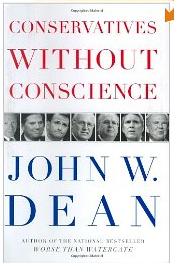
I close with this quote from John Dean’s Conservatives Without Conscience, “… time has run out, and the next two or three national election cycles will define America in the twenty-first century … ”

  • Share/Bookmark


Gasoline Prices – Now With Prices and Emotions Falling, A Little Perspective

Written by: Andy Hailey @ 9:13 PM
Posted under: Energy

According to the Energy Information Agency (EIA) of the U. S. government, “In 2005 the price of crude oil averaged $50.23 per barrel, and crude oil accounted for about 53 percent of the cost of a gallon of regular grade gasoline. Taxes (not including county and local taxes) account for approximately 19 percent of the cost of a gallon of gasoline. Refining costs and profits comprise about 19 percent of the retail price of gasoline. Distribution, marketing and retail dealer costs and profits combined make up 9 percent of the cost of a gallon of gasoline.”

Components of gasoline price

Also available from the EIA are the historical crude and gasoline prices. The chart below displays these EIA data from 1978 to 2006. All prices are adjusted to 2005 dollars. The red line represents the average annual U. S. domestic crude oil cost. The blue line is for the average annual cost of retail gasoline – all grades. The numbers for 2006 are an estimate based on 2006 data from the EIA.


Chart comparing crude to gasoline prices


Click on image for full view.

Note that the prices for crude oil are for one tenth (1/10) of a barrel to provide scale.

Do you see the correlation and that maybe gasoline prices could have been much higher if the correlation was tighter?

  • Share/Bookmark


September 20, 2006

September 2006, WAWG Index – Up A Suprising 195%

Written by: Andy Hailey @ 8:32 PM
Posted under: WAWG Index

In this twelfth survey of the web, The WAWG Index category group average was up by 194.7 percent from August 2006. Of the fourteen categories tracked, 2 were down slightly, 12 were up quite a bit, and 0 were unchanged. The cumulative change for the index is up 259 percent since October 2005, and at a new high.

By far, the largest change for September, at 1,648%, was for “obsession with crime and punishment”. The next largest increase was for “rampant sexism” at 192%. In third place was “obsession with national security” – 178%.

The largest drop for the month was 31 percent for “fraudulent elections.”

A random sampling of the search results for those items up by triple digits, appears to be the result of many postings of Lawrence W. Britt’s 14 characteristics of fascism, which helped lead to the creation of this site.

Maybe this index is taking on a new meaning: an awakening to the single-party trends that have been happening for years as opposed to trends sliding by unnoticed.

  • Share/Bookmark


September 16, 2006

War(?) On Terror – No, Only An Excuse to Break the Law and Lower Our High Standards

Written by: Andy Hailey @ 9:13 AM
Posted under: Authoritarianism

Illustration by Victor Juhasz

Many insist on calling our efforts to fight a relatively small group of individuals a war. I think this national endeavor is giving the terrorists far too much credit and we are only empowering them to have more control over our lives by doing so. The phase “war on terror” and the various al-Qaeda videos are being used to scare us out of reasoning and manipulate us both from within and from without. It is time for a little perspective about what war means, what its use has allowed to happen to this nation and how best to combat this new threat.

On December 7, 1941, we were attacked by a force far more formidable than the 19 terrorists of 9/11/2001 and their brothers in arms hiding in Afghanistan/Pakistan – the Japanese Navy. Japanese funding and military power far exceeded that from al-Qaeda.

The Japanese hit America with between 150 and 200 planes from several aircraft carriers. The Japanese attack struck at almost the entire Pacific fleet. Pearl Harbor contained eight battleships, seven cruisers, 28 destroyers, and five submarines. Nineteen of these 48 ships were sunk or severely damaged. The attackers also destroyed 177 Navy and Army aircraft.

Unfortunately, there is just one fact that is comparable between these two vicious attacks on America. Just like 9/11/2001, there was the tragic loss of fellow Americans. The losses for the Navy and Marines were 2,117 killed, 960 missing and unaccounted for and 876 wounded. For the Army, 226 were killed and 396 wounded. Civilian casualties included 49 killed and 83 wounded. The total killed or missing and presumed dead was 3,352. (Encyclopedia Americana, 1953, volume 21, page 437.) Wikipedia has more and slightly different details, but it is still obvious that the Japanese were much more of a threat than al-Qaeda can ever hope to be.

To put this war(?) on terror in further perspective relative the the attack by the Japanese, it will help to look back at how Americans responded to this loss of 3,352 Navy, Army and civilian brothers, sisters, fathers and mothers. What did they do? What did they sacrifice? How many joined the military to help defeat the enemies? How much of the economy went to support the war. What became the goal of every worker?

For answers to some of these questions and what it takes from a nation to fight a real war, here are some quotes from Tom Brokaw’s The Greatest Generation: (Emphasis and current related data added.)

Looking back, I can recall that the grown-ups all seemed to have a sense of purpose that was evident even to someone as young as four, five, or six. Whatever else was happening in our family or neighborhood, there was something greater connecting all of us, in large ways and small.

Indeed there was, and the scope of the national involvement was reflected in the numbers: by 1944, twelve million Americans [9.1% of the 1940 population] were in uniform [In 2002, there were 1.4 million (0.5% of 2002 estimated population) in service to America.]; war production represented 44 percent of the Gross National Product [In 2005, the budget for the Department of Defense was about 3.6 percent of the nation's GDP]; there were almost nineteen million more workers [13.6% of 1945 population] than there had been five years earlier [From January 2001 to December 2005, job growth was a little over ten million workers, or 3.4% of 2005 estimated population], and 35 percent of them were women. The nation was immersed in the war effort at every level.

… more than a million men would go into uniform immediately … [From Mourning Has Broken ; "in the two years since September 11, he [President Bush] has not once publicly urged young people to join the military, nor has he called for increasing the active-duty roster. “]

If we are in a full fledged high-demand war, why wouldn’t the president be asking for more enlistees? Why aren’t we buying war bonds? Why isn’t there gas rationing to help fuel our military machines? Why aren’t we recycling scrap metal and rubber to provide for the troops material needs? — Why are we shopping and going to the movies like there is no war?

I am not saying Americans did not respond to 9/11/2001. We all did. However, except for our service men and women and their families, most of us have not made any significant or long term serious commitment as was done by The Greatest Generation. Why is that? Because this is not an endeavor that requires the effort of the entire nation.

In WWII, this nation took on, with the help of friends we no longer have, and defeated two large well-prepared enemies in less time than has already been spent on President Bush’s war(?) on terror. But that kind of commitment is not what we need now.

Robert Dreyfus put the current terrorist threat this way:

Compared to the Al Qaeda of 2001, this new generation of terrorists is mostly amateurs, less likely and less capable of pulling off truly spectacular acts of violence. Though they can cause significant casualties from time to time, counter-terrorism officials say, they are more like a low-grade viral infection — life-threatening only if left unattended. “There is a relatively small number of people who are out there trying to hurt us,” says James Steinberg, a deputy national-security adviser under President Clinton.

McVeigh's police mug shot

If the national commitments and real threat for this war(?) on terror are so small compared to WWII, what is there to be so scared of? More importantly, if this is not a war, what are we doing giving up our civil rights, turning our back on our international friends, taking preemptive actions and and lowering our moral standards?

Maybe we should be responding to the attack on 9/11/2001 more in terms of the response to Timothy McVeigh and the “deadliest terrorist attack on US soil prior to the September 11, 2001.”

This is a law enforcement issue, not a war, that requires the cooperation of citizens, and local, state, national and international intelligence organizations. So stop letting the social dominator authoritarians scare you and consider voting them, and their intolerant, narrow-minded followers, out of office so we can attack this national endeavor the right way – with intelligence, citizen vigilance, law enforcement and valid actionable information.

  • Share/Bookmark


September 11, 2006

Keeping Fear of Terrorism in Perspective – And Putting Reasoning Back Into Our Decision Making Processes

Written by: Andy Hailey @ 12:59 AM
Posted under: AuthoritarianismTerrorism

Are you tired of being scared? Maybe a little perspective would help?

Do you fear dying from heart disease?  700,142  Americans were kill by it in 2001.

Do you fear dying from cancer?   553,768  Americans were kill by it in 2001.

Do you fear dying from an accident of any kind?  101,537  Americans were killed accidentally in 2001.

Do you fear dying from suicide?  30,622  Americans took their own lives in 2001.

Do you fear the loss of a infant?  27,801 infants died in 2001.

Do you fear dying from homicide?  17,330 Americans were murdered in 2001.

Do you fear dying from a work injury?  5,431  Americans were died at work in 2001.

Do you fear dying from drowning?  3,247  Americans drowned in 2001.

If we don’t fear most of these causes of death, then why should we fear dying at the hands of a terrorist. It is less likely than any of the above. On the other hand, if we are in a state of fear due to the constant drumbeat from the authoritarians in the Republican party, how reasoned are any decisions we might make?

Luke Mitchell wrote an article back in March 2004, the last time fear was used by the Republican authoritarians to short circuit our brains. Luke Mitchell began his article with this, “Terror, like ecstasy, tends to magnify perceptions. Just as affection becomes adoration in the physical act of love, so too does vigilance sometimes become morbid obsession in the face of spectacular violence. To be effective, this normal function of survival must also be temporary. It is now more than two years since our own national incident of spectacular violence, however, and although the United States remains obsessed, it is not unfair, or even insensitive, to begin considering the events of September 11 from a more detached perspective.” (Mitchell’s article provided the above statistics.)

In the “Legitimizing Authoritarian Conservatism: The Ugly Politics of Fear” section of his book Conservatives Without Conscience, John Dean concluded with, “In short, fear takes reasoning out of the decision-making process, which our history has shown us often enough can have dangerous and long-lasting consequences.  If Americans cannot engage in analytical thinking as a result of Republicans’ using fear for their own political purposes, we are all in serious trouble.  I am sure I am not alone in worrying about the road that we are now on, and where the current authoritarianism is taking the country.  I only wish other people would talk about it.”

Ted Galen Carpenter of the CATO Institute, put it this way, “Compared to the lethal menaces of the twentieth century, the strategic threat posed by radical Islamic terrorists is minor league. On September 11th, 2001, the terrorists killed some 3,000 people, and subsequent attacks in Bali, Madrid, Istanbul, London and Mumbai have killed hundreds more. Tragic as those deaths are, they pale in comparison to the nearly 100 million deaths of the two world wars.”

Our job, according to Bruce Schneier of Wired magazine,

is to remain steadfast in the face of terror, to refuse to be terrorized. Our job is to not panic every time two Muslims stand together checking their watches. … Our job is to think critically and rationally, and to ignore the cacophony of other interests trying to use terrorism to advance political careers or increase a television show’s viewership.

The surest defense against terrorism is to refuse to be terrorized. Our job is to recognize that terrorism is just one of the risks we face, and not a particularly common one at that. And our job is to fight those politicians who use fear as an excuse to take away our liberties and promote security theater that wastes money and doesn’t make us any safer.

Please keep the fear of terrorism in perspective and think about doing what is best for this country and keeping us from being scared into a single-party authoritarian state.

  • Share/Bookmark


September 8, 2006

Government by the Party, for the Party, and of the Party – Part 1a, The House that Newt Built

Written by: Andy Hailey @ 4:10 PM
Posted under: Authoritarianism
Tagged with:

As I said in Failed Single Party Nations of the Past – Where Are We Going Now?, “Nations run by a single party (political, army or dictatorship) tend to become intensely nationalistic, racist, militaristic and imperialistic. They are supported by the ‘masses’ but not necessarily the majority of the national population. Support for this system is enhanced by identifying an ‘enemy’ and its ‘supporters’, labeling them with prejudicial adjectives and urging the masses to support violence against them.” That article was about the past. This article, and the three that follow, are about the initial stages of converting our Democracy into a single party system. They are about high-level authoritarian leaders from a “single party” and the right-wing authoritarian followers that are the “masses.”

In the previous article, I concluded with, “So, who are these Leaders that we need to get out of public office before they turn this country upside-down?” I have come to believe that they are the Double High authoritarians as identified by John Dean’s review of the situation in Conservatives Without Conscience. They are listed in this series of four posts along with their identified authoritarian traits and the infamous deeds they have used, and will continue to use, to bring us to a single party system of authoritarians. I have added some family history, but there is no proven relationship between this and the other information presented here.

Please note: Not all conservatives are after this single party goal – only those with authoritarian personalities.

John Dean provided a little perspective to this threat, “Political Authoritarianism in America still pales in comparison with that in countries like China and Russia ….” However, under the heading of “Authoritarian Origins of Social Conservatism” John Dean asserts that, “Any representative list of the major players in launching this movement should include J. Edgar Hoover, Spiro T. Agnew, Phyllis Schlafly and Paul Weyrich.” John later adds, “Christian Conservatives’ primary tool in reinforcing authoritarianism is preaching fear, and no one does so more than the head of the Christian Coalition, Pat Robertson.”

I leave the details of those authoritarians to John Dean’s words and go on to a more current list of Social Dominators, their families, their traits and their deeds. I need to point out here that what follows just barely scratches the surface of how the Republicans plan, according to John Dean, “to build a permanent majority in America, and a one-party rule”.

John Dean started off the chapter on these single party authoritarians with, “While authoritarian conservatism was growing in force in Washington for a decade before Bush and Cheney arrived at the White House, their administration has taken it to its highest and most dangerous level in American History. It is doubtful they could have accomplished this had authoritarian conservatism not already taken hold on Capitol Hill …. … it is difficult to think of anyone who has done more to poison national politics … than Gingrich and Delay.”

An authoritarian who wants to be our President
Newt Gingrich – Served: 1979 to 1999, Speaker: 1995 to 1999
Family Background
Here’s how Gail Sheehy introduced him in her PBS Frontline interview in 1995, “From the cauldron of his childhood — the father who abandoned him, the manic depressive mother who loved him too much, the stepfather whose anger shaped the family — Newt Gingrich emerged with a heroic need that became his mission. Talking to his inner circle of family, friends, and associates, and to the Speaker himself, GAIL SHEEHY learns the details of Newt’s wars, his women, and his contract with himself.”
Here are some of Gingrich’s own words from the above interview:

  • “My father grew up as a very angry person. When he signed up for the navy, the recruiting officer said, ‘Why did you fill out your application wrong?’ He said, ‘What do you mean?’ And he said, ‘You put your grandmother’s name in where your mother’s name should be.’ He found out that he had been born out of wedlock. They never told him. Talk about being outraged!”
  • “Big Newt was physically enormous. Six foot three, and could use a nine-pound sledgehammer with one hand. I’d say from the time he was 16 to 35 he was in bar fights…My mother was very frightened of him. So she decides to file for divorce. He tries to talk her out of it, fails, scares her even more, so she divorces him and then marries Bob Gingrich, who is also adopted…So that’s the background, and people assume I’m some right wing, out-of-touch Neanderthal who doesn’t get it. I mean, I’m adopted! Both of my fathers are adopted! I mean, give me a break!”
  • “I was nearsighted –something I didn’t realize until I was about 12.”
  • “They’re [father and step father] both angry. They both served in the military. They’re both physically strong. They both believe in a very male kind of toughness. They’re both totalitarian. Not much difference between them.”
Authoritarian_Traits
From Lee Howell, Newt’s press secretary in 1974, once observed, “Very candidly, I don’t think that Newt Gingrich has many principles, except for what’s best for him, guiding him.”
From Chip Kahn, ran two of Newt’s campaigns and has known him for 16 years: “I don’t know whether the ambitious bastard came before the visionary, or whether because he’s a visionary, he realizes you have to be tough to get where you need to be.”
From Mary Kahn: “Newt uses people and then discards them as useless. He’s like a leech. He really is a man with no conscience. He just doesn’t seem to care who he hurts or why.”
FromL.H. Carter, among Gingrich’s closest friends and advisors, “You can’t imagine how quickly power went to his head. The important thing you have to understand about Newt Gingrich is that he is amoral. He’s probably one of the most dangerous people for the future of this country that you can possibly imagine. He’s Richard Nixon, glib. ”
From Suzanne Garment’s book Scandal, New Gingrich “brought scandal politics unmistakenly home to the Congress.”
From John Dean, “[David] Osborne reported that Gingrich was dominating, opposed to equality, desirous of power, and amoral; he can be a bully, hedonistic, exploitive, manipulative, a cheater, prejudiced toward women, and mean-spirited, and he uses religion for political purposes; he also wants others to submit to his authority and is aggressive on behalf of authority.”
Infamous Deeds
Keep in mind that all of the following occurred while the Democrats held the majority in the House and it was Gingrich’s plan to change that. How do you do that? You make the House and the Democrats look as bad as possible. They still have a tarnished image that may never go away.
In 1984 Gingrich organized a C-Span propaganda blitz. He lined up Republicans to speak during off-hours on the House floor and say whatever they wanted to about their opponents. Later these speeches would be rebroadcast and the viewers could assume the Congressman was speaking to an occupied (but actually empty) chamber.
After Tip O’Neill, the Democratic Speaker of the House, retired in 1987, Gingrich exposed the use of large overdrafts from the House Bank by Congressmen and “portrayed the Republicans as godly and Democrats as anti-religious liberals. The Columbia Journalism Review put this and other Gingrich handy work this way, “Encouraged by the Gingrich machine, reporters took up not only the House post office scandal (a serious matter) but also the House bank overdraft affair. This was minor, involving no tax money, but they played it like another Teapot Dome. Unpaid House restaurant lunch bills of certain members became another Abscam. And so it went until the country, pining for change, dumped the Dems and put Gingrich in as Speaker.”
According to Dan T. Carter in From George Wallace to Newt Gingrich: Race in the Conservative Counterrevolution, during Gingrich’s effort to oust the Democrats he provided a list of keywords to fellow Republicans for describing the Democrats as the enemy: “sick, traitors, corrupt, bizarre, cheat, steal, devour, self-serving and criminal rights.”
Once upon a time, House Committees were chaired based on a seniority system, but Gingrich abolished that and set up a centralized party-based system that reported to him as Speaker of the House.
The House workweek had been shortened to three days, and C-SPAN and electronic voting minimized Republican exposure to Democrats by keeping everyone in their offices thus making it a lot easier to call Democrats names, drop all forms of civility and take over the House in 1979.

  • Share/Bookmark


Government by the Party, for the Party, and of the Party – Part 1b, The Double High House of Delay

Written by: Andy Hailey @ 4:08 PM
Posted under: Authoritarianism
Tagged with:

Twenty years after the Republican take over of the House, it was time for Gingrich to leave and let the next aggressive authoritarian take over and continue the transformation of the House to support a single party system. According to John Dean, Paul Weyrich had this to say about the former Speaker of the House, “Newt Gingrich is the first conservative I have ever known who knows how to use power.” John then concluded with, “In fact, there was someone else Weyrich would come to know who used power even more aggressively and ruthlessly than Gingrich: Tom Delay.”

Tom Delay - Wikipedia
Tom Delay – Served: 1984-2006, 1994-2006 as Majority Whip/Leader
Family Background
From Wikipedia, “DeLay has declined to comment on reports in The New Yorker that he is estranged from much of his family, including his mother and one of his brothers. DeLay has not spoken to his younger brother, Randy, a Houston lobbyist, since 1996, when a complaint to the House Ethics Committee prompted Tom DeLay to cut his brother off in order to avoid the appearance of a conflict of interest.”
From New York Times June, 1999, “My father was a wildcatter typecast straight out of the movie ‘Giant’. He was a boisterous, domineering alcoholic. We were not exactly an ideal family.” He went on to say, “I was a real jerk when I got elected. Me, me, me. My job was my religion and I was mistreating my wife and daughter.”
Authoritarian Traits –
“By the time we finish this poker game, there may not be a federal government left, which would suit me just fine.”
John Dean writes, “Tom Delay’s Double High authoritarian personality offers an almost textbook example of the four defining elements of a social dominator: the tendency to dominate; opposition to equality; desire for personal power; and amorality. … Delay, in a pattern followed by many Double High authoritarians, became a born-again Christian in 1984.”
From The Two Faces of Tom Delay, “his actions have been corrupt, illegal and unethical. “
According to John Dean, “Delay’s opposition to equality is less conspicuous, but it is certainly evident in the Texas redistricting plan he brokered ….”. Relative to District 23, 5 justices agreed that the Voting Rights Act had been violated.
From Chris Shays, “If it wasn’t illegal to do it, even if it was clearly wrong and unethical, and in some cases it was even illegal, they still did it. There are a lot of people who cozied up to Tom because he had so much say in their lives as a legislator and they’re going to be hurt by it.”
Relative to Tom Delay’s control of K-Street lobbyists and getting a liberal, Dave McCurdy, fired from the Electronic Industries Association lobby, John Dean wrote, “Extortion is not something that registers easily with a Double High authoritarian who is busy manipulating the world.”
Infamous Deeds
According Robert Kuttner’s America is a One-Party State, “The United States could become a nation in which the dominant party rules for a prolonged period, marginalizes a token opposition and is extremely difficult to dislodge because democracy itself is rigged. This would be unprecedented in U.S. history.” Under the section titled Legislative Dictatorship, Kuttner stated, “Political scientists used to describe America’s Congress as a de facto four-party system. There were national Democrats, mostly liberals; “Dixiecrats,” who often voted with Republicans (Congressional Quarterly called this the conservative coalition and tabulated its frequent wins); conservative Republicans; and moderate-to-liberal “gypsy moth” Republicans, who selectively voted with Democrats.” The following is also from Kuttner’s analysis.
Extreme Centralization – “The power to write legislation has been centralized in the House Republican leadership. Concretely, that means DeLay and House Speaker Dennis Hastert’s chief of staff, Scott Palmer, working with the House Committee on Rules. (Hastert is seen in some quarters as a figurehead, but his man Palmer is as powerful as DeLay.) Drastic revisions to bills approved by committee are characteristically added by the leadership, often late in the evening. Under the House rules, 48 hours are supposed to elapse before floor action. But in 2003, the leadership, 57 percent of the time, wrote rules declaring bills to be “emergency” measures, allowing then to be considered with as little as 30 minutes notice. On several measures, members literally did not know what they were voting for.”
No Amendments – “DeLay has used the rules process both to write new legislation that circumvents the hearing process and to all but eliminate floor amendments for Republicans and Democrats alike. The Rules Committee, controlled by the Republican leadership, writes a rule specifying the terms of debate for every bill that reaches the House floor. When Democrats controlled the House, Republicans complained bitterly when the occasional bill did not allow for open floor amendments. In 1995, Republicans pledged reform. Gerald Solomon, the new Republican chairman of the committee, explicitly promised that at least 70 percent of bills would come to the floor with rules permitting amendments. Instead, the proportion of bills prohibiting amendments has steadily increased, from 56 percent during the 104th Congress (1995-97) to 76 percent in 2003. This comparison actually understates the shift, because virtually all major bills now come to the floor with rules prohibiting amendments.”
One-Party Conferences – The Senate still allows floor amendments, but Senate-passed bills must go to conference with the House. Democratic House and Senate conferees are increasingly barred from attending conference committees, unless they are known turncoats. On the Medicare bill, liberal Democratic Senate conferees Tom Daschle and Jay Rockefeller were excluded. The more malleable Democrats John Breaux and Max Baucus, however, were allowed in. [See Matthew Yglesias, "Bad Max," page 11.] All four House Democratic conferees were excluded. Republican House and Senate conferees work out their intraparty differences, work their respective caucuses and send the (nonamendable) bill back to each house for a quick up-or-down vote. On the Medicare bill, members had one day to study a measure of more than 1,000 pages, much of it written from scratch in conference.
No Legislative Hearings – “Before the DeLay revolution, drafting new legislation in conference committee was almost unknown. But under DeLay, major provisions of the Medicare bill sprang fully grown from a conference committee. Republicans got a conference to include a weakened media-concentration standard that had been explicitly voted down by each house separately. Though both chambers had voted to block an administration measure watering down overtime-pay protections for workers, the provision was tacked onto a must-pass bill in conference. The official summary of House procedures, written by the (Republican-appointed) House parliamentarian and updated in June 2003, notes: ‘The House conferees are strictly limited in their consideration to matters in disagreement between the two Houses. Consequently, they may not strike out or amend any portion of the bill that was not amended by the other House. Furthermore, they may not insert new matter that is not germane to or that is beyond the scope of the differences between the two Houses.’ Like the rights guaranteed in the Soviet constitution, these rules are routinely waived.”
Appropriation Bill Abuses – “Appropriations bills are must-pass affairs, otherwise the government eventually shuts down. Traditionally, substantive legislation is enacted in the usual way, then the appropriations process approves all or part of the funding. There has long been modest abuse in the form of earmarked money for pet pork-barrel projects and substantive riders being tacked onto appropriations bills. But since Gingrich, a lot of substantive bill drafting has been centralized in House leadership task forces appointed by the majority leader. And under DeLay, Appropriations subcommittee chairs must now be approved by the leadership, as well as by the Appropriations chairman.

“…DeLay has made the railroading systematic.

“To enforce party discipline, the DeLay operation has also perfected a technique known as ‘catch and release.’ On close pending votes, the House Republican Whip Organization, with dozens of regional whips, will target, say, the 20 to 30 Republican members known to oppose the legislation. When the leadership gets a final head count and determines just how many votes are needed, some will be reeled in and others let off the hook and given permission to vote ‘no.’

“In short, some of these maneuvers had embryonic antecedents, but under DeLay differences in degree have mutated into an alarming difference in kind. Wright’s regime lasted just one congressional session. It ended unceremoniously when a minor ethics breach (Wright’s bulk sales of his book) was bootstrapped into a major scandal by a Republican back-bencher named Gingrich, leading to Wright’s resignation and his replacement by the far less partisan Tom Foley, and then to the Democrats’ loss of the House in 1994. DeLay’s regime shows every sign of going on and on and on — with abuses of which the Democrats never dreamed.”

John Dean, while referencing the Wall Street Journal, concluded with, “at the end of 2005 there were a staggering 13,998 earmarked expenses, costing $27.3 billion. When the Republicans took control [of the House] in 1995 there were only 1,439 earmarked items. Needless to say, there is nothing conservative in these fiscal actions but there is much that is authoritarian about the wanton spending by these Republicans.”
According to John Ydstie, “Tom DeLay was elected Majority Whip by his Republican colleagues after they took control in 1994. Almost immediately, he launched a program seeing to it that the Republicans stayed in power. It was called the ‘K Street Project’ …. The goal was to make K Street a Republican bastion so that the money contributed by K Street’s rich political action committees flowed only to Republicans.”
In September 2004, The Economist, “by gerrymandering to cram Democrats into a smaller number of super-safe seats … while spreading Republicans into a larger number of ‘designer districts which they win by 55-60%,” the Republicans have created a permanent majority and re-election rate of 99% which “North Korea might be proud of ….”
The One-vote Victory – From Juliet Eilperin, “Time and again, on high-profile bills involving Medicare, education and other programs, Hastert and his lieutenants [Tom Delay, Roy Blunt and other GOP leaders] have calibrated the likely yeas and nays to the thinnest margin possible, enabling them to push legislation as much to their liking as they can in a narrowly divided and bitterly partisan House.”

  • Share/Bookmark


Government by the Party, for the Party, and of the Party – Part 2, The Frist Mini-House Senate

Written by: Andy Hailey @ 4:07 PM
Posted under: Authoritarianism
Tagged with:

According to John Dean, the Senate “is not yet an authoritarian body,” however, “This is not to say there is no authoritarianism in the Senate.” The Republicans are anxious “to extend their power in the Senate in a fashion similar to what they have in the House.” John points out that they “are oblivious to the fact that by doing so they would make the Senate into a mini-House of Representatives, thereby fundamentally changing the interaction between the inherently cautious Senate and the more impulsive House.”

The Senate’s transformation has been less dramatic than the House’s. One area of change is protection of minority views by preventing tyranny of the majority the filibuster. According to John Dean, “The first recorded occasion when a minority senator used extended debate to defeat a proposal was in 1790.” During the early 1800s, this “lengthy debate” technique became “something of a common procedure.” By 1856, the Senate formalized the procedure in the Senate’s rules. At FindLaw.com, John wrote this history summary:

In 1917, during the Presidency of Woodrow Wilson, the Senate adopted a rule permitting a “cloture vote” by a two-thirds supermajority of its members to end a filibuster.

Yet the Senate did not invoke cloture even once from 1927 until the early 1960s; each of its members wanted to keep the filibuster right himself, and thus did not want to impose a cloture vote on another member. In 1939, Jimmy Stewart’s portrayal of a heroic use of the filibuster in “Mr. Smith Goes To Washington” only decreased the public image of the cloture vote.

In the mid-1950s and early 1960s, however, it was the filibuster that became the villain. A few Southern Senators used it to prevent the passage of laws assuring African Americans the basic rights of education, the vote, decent housing and public facilities to which they were entitled.

Indeed, Southern Democrats tied up the landmark 1964 Civil Rights Act with a seventy-four day filibuster, with newspapers and television covering the bigoted Southern intransigence. That was enough to outrage Americans everywhere, and change public attitudes about the filibuster.

With this public attitude change came another change to the Senate’s rules. According to the above FindLaw article, Senate majority leader Mike Mansfield introduced the “two-track” system: “The Senate is generally a collegial body – doing much of its business, of necessity, by ‘unanimous consent.’ Under Mansfield’s ‘two track’ system, the Senate agreed, by unanimous consent, to spend its mornings on the matter being filibustered, and the afternoon on other business.”

This “minority veto” requires a two-thirds supermajority, which the Republicans don’t currently have, to override it. Since the Senate is becoming more authoritarian as former members of the House move to the Senate, they are resorting to cheating through a parliamentary trick referred to as the “nuclear option.” The result would replace the supermajority with a simple majority, bring an end to the minority veto and the Senate would become a mini-House run by a few authoritarians.

For more on the filibuster, refer to The Filibuster, by Professors Catherine Fisk and Erwin Chemerinsky

Senator Bill Frist Bill Frist – Served: 1994 to 2008, Majority leader since 2003
Family Background
In 1968, Dr. Thomas F. Frist Sr. (father), Jack C. Massey and Dr. Thomas Frist, Jr. (brother) formed their own hospital management company – Hospital Corporation of America, today known simply as HCA. HCA is composed of locally managed facilities that include approximately 191 hospitals and 82 outpatient surgery centers in 23 states, England and Switzerland.
Thomas Frist, Jr. – 451st richest person in the world. Came out of retirement to help revive the company during a lengthy Medicare-fraud investigation.
Thomas Fearn Frist Sr. is widely recognized as the father of the modern for-profit hospital system.
Authoritarian Traits
From John Dean, “Frist is Richard Nixon with Bill Clinton’s brains, and Nixon was no mental slouch. Frist is without question a social dominator [authoritarian] … No one describes Bill Frist’s dominating personality better than Frist himself in his first book, Transplant: A Heart Surgeon’s Account of the Life-and-Death Dramas of the New Medicine.” In his book, Bill wrote that he could “hardly help but be a demanding little tyrant. … I ruled not just over my family but over my friends – or should I say subjects – who always opted to come to my house.”
Under the trait of “manipulating to succeed” and “justifying his own conduct,” John Dean provided the following quote from Frist’s book relative to a medical project using cats and their hearts, “Desperate, obsessed with my work, I visited various animal shelters in the Boston suburbs, collecting cats, taking them home, treating them as pets for a few days, then carting them off to the lab to die in the interest of science ….”
Infamous Deeds
Led the Senate to the brink of destroying the minority veto (filibustering) with the nuclear option.
On June 13, 2005, Frist sold his shares in HCA. This was just before HCA reported its earnings for the second quarter would not meet analyst expectations. The stock then dropped about 15 percent.
Here is what he said on Terri Schiavo, “There seems to be insufficient information to conclude that Terri Schiavo is in a persistent vegetative state. I don’t see any justification in removing hydration and nutrition.” However, an autopsy showed that Terri was not only blind but her brain had atrophied to about half its expected size.
From The Seattle Times, “Opposition to McCain and Graham was led by Senate Majority Leader Bill Frist, R-Tenn., and members of the Senate Intelligence Committee, the National Security Council staff and White House lobbyists. Frist ultimately voted for the amendment.”

  • Share/Bookmark


Government by the Party, for the Party, and of the Party – Part 3, The Cheney Executive Branch

Written by: Andy Hailey @ 4:06 PM
Posted under: Authoritarianism
Tagged with:

In this fourth in a series of four, I start with a few quotes from John Dean about Dick Cheney, which John backs up with other details in his book, Conservatives without Conscience:

Cheney is an authoritarian dominator.

Dick Cheney is the most powerful vice president in American History.

Unlike prior vice presidents, Cheney and his people have often taken the lead on issues, with the White House Staff falling in line.

Bad judgement is Dick Cheney’s trademark.

The issue of Dick Cheney’s judgement must be raised because he is the catalyst, architect, and chief proponent of Bush’s authoritarian policies. In fact, Cheney’s authoritarian vice presidency has simply swallowed the presidency, and Cheney sought to take the office way beyond even Nixon’s imperial presidency ….

Rather than vetoing legislation …, the White House (read: Cheney and his staff) issues a brief [signing] statement giving its interpretation of the new law as it relates to presidential powers.

Cheney is the mind of this presidency, with Bush as its salesman.

Frightening Americans … has become a standard ploy for Bush, Cheney, and their surrogates. [Fear: Its Political Uses and Abuses Vice President Al Gore: Keynote address, Webcast - start @12:23]

Cheney is surely proof of the Peter Principle.

Cheney’s career reveals that it is marked by upward mobility and downward performance.

Dick Cheney

Dick Cheney

Family Background
Cheney’s father, Richard Herbert Cheney a registered Democrat, worked as a soil conservation agent for the U.S. Department of Agriculture.
Dick Cheney has a brother, Bob, and a sister, Susan.
Dick met his future wife, Lynne Vincent, in high school at the age of 14. They were married in 1964 and now have two adult daughters, Elizabeth and Mary, and four grandchildren.
Authoritarian Traits
From John Dean, “the vice president is a classic Double High.”
From John Dean, “Cheney, it appears, knows how to manipulate the president like a puppet, and handles his oversized ego by making him believe ideas or decisions are his own when, in fact, they are Cheney’s.”
From John Dean, “Among the most troubling of the authoritarian and radical tactics being employed by Bush and Cheney are their politics of fear.”
Josh Marshall, wrote a piece in the Washington Monthly called, “Vice Grip: Dick Cheney is a man of principles. Disastrous Principles.” In this piece, he stated:

  • “… they have an extreme assurance in their own judgment about what is best for the country and how to achieve it [dominating]. “
  • “If there are other groups (shareholders, voters, congressional committees) who agree with you, fine, you use them [exploitive, manipulative].”
  • “Not since the Whiz Kids of the Kennedy-Johnson years has Washington been led by men of such insular self-assurance [highly self-righteous].”
Infamous Deeds
From John Dean, “It was not George Bush who came up with the idea of imposing blanket secrecy on the executive branch when he and Cheney took over.  It was not George Bush who conceived of the horrible – and in some cases actually evil – policies that typify this authoritarian presidency, such as detaining “enemy combatants” with no due process and contrary to international law.  It was not George Bush who had the idea of using torture during interrogations, and removing restraints on the National Security Agency from collecting intelligence on Americans.  These were the policies developed by Cheney and his staff, and sold to the president, and then imposed on many who subsequently objected to this authoritarian lawlessness.  It was Dick Cheney and his mentor [read bully duo], Secretary of Defense Donald Rumsfeld, who convinced Bush to go to war in Iraq ….”
From John Dean, ” … the best thing Cheney did for Haliburton as Chairman and CEO was to step down and help them get no-bid contracts to rebuild Iraq and federal help with their asbestos claims liability.”
Back in 1974, Dick Cheney, Antonin Scalia and Rumsfeld convinced President Ford to veto a bill that would have strengthened the 1966 Freedom of Information Act.
He still refuses to lift the veil of secrecy on his White House Energy Task Force and he may have lied to Congress in the process.
From USA Today, “Vice President Dick Cheney has lobbied Republican senators to allow an exemption [to the use of torture] for those [terrorists] held by the CIA ….”

John Dean had the following to say at the end of his book about the top office holders in our government:

Nixon for all his faults, had more of a conscience than Bush and Cheney. They cannot think of a mistake they have made since coming into office, and in doing so display self-righteousness far beyond Nixon’s. Bush and Cheney are Double High authoritarians, far above Nixon’s league.

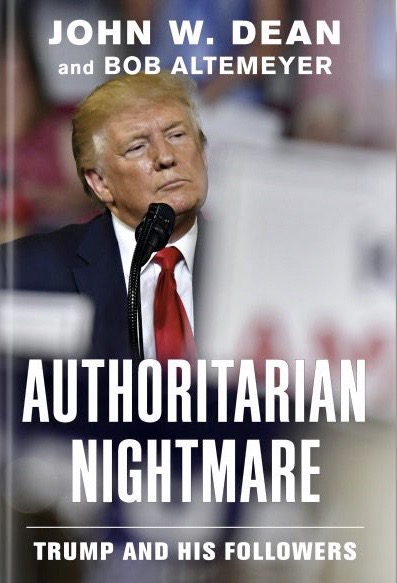
What has driven Mr. Dean’s book is the realization that our government has become largely authoritarian. It is run by an array of authoritarian personalities – leaders who display all those traits I have listed – dominating, opposed to equality, desirous of personal power, amoral, intimidating and bullying; some are hedonistic, most are vengeful, pitiless, exploitive, manipulative, dishonest, cheaters, prejudiced, mean spirited, militant, nationalistic and two-faced.

They are able to do so because the growth of contemporary conservatism has generated countless millions of authoritarian followers ….

John goes on to quote Bob Altemeyer on the right-wing authoritarian followers that have helped elect the above leaders:

Probably about 20 to 25 percent of the adult American population is so right-wing authoritarian, so scared, so self-righteous, so ill-informed, and so dogmatic that nothing you can say or do will change their minds. They would march America into a dictatorship and probably feel that things had improved as a result. … And they are so submissive to their leaders that they will believe and do virtually anything they are told. They are not going to let up and they are not going away.

John Dean then concludes with, “… time has run out, and the next two or three national election cycles will define America in the twenty-first century … ”

In Failed Single Party Nations of the Past – Where Are We Going Now?, I summarized the conversion of another nation into a single party state of social dominators that was enabled by the “masses” of the right-wing authoritarian followers.

  • Share/Bookmark