










In American, personal wealth will be redistributed one of two ways: taxation and accountability, or the lack thereof. Will redistribution recreate a wealthy aristocracy this nation rebelled against long ago, or will it provide for the common good and give all citizens an equal chance at creating their own wealth?
America’s wealth redistribution will either benefit all of us or a select few at the expense of all of us. America’s wealth redistribution will either raise all boats or only those that can be well maintained. America’s wealth redistribution will either enrich the common good or engorge the well off. America’s wealth redistribution will either create and maintain a foundation for our democracy and our infrastructure, or let both crumble for the sake of self-interest. America’s wealth redistribution will either protect citizens and their shared resources from abuse or empower the abusers as they ravage the shared resources and protect their ‘individual’ gains. America’s wealth redistribution will either empower all citizens to become wealthy or empower a few to control most of the nation’s wealth. America’s wealth redistribution will either provide for a broad based common wealth, which gives all citizens a equal chance for success and building personal wealth, or will concentrate wealth and power in a very wealthy aristocracy.
For the last 60 years, our tax laws have favored the very wealthy at the expense of other Americans not like them. The tax cuts for the wealthy are highlighted by the chart below which shows the drop in the highest tax rate between 1945 and 2008.
60 Years of Tax Cuts for the Rich
As detailed in another posting, the impact of the above tax cuts has given 16 percent of American families, those who make over $105,000, a 361 percent greater tax cut than the other 84 percent of American families. America’s growing, but young, plutocracy is becoming wealthier and more powerful.
To these tax cuts, add the surreptitious use of privateering. Privateering takes a portion of the remaining tax revenues and diverts it to companies like Blackwater and other sole-source defense contractors, or to ‘too-big-to-fail’ banks. And so the wealthy CEOs get richer still and more powerful.
This redistribution of the nation’s wealth to the wealthy is also shown by the chart below. It shows how family income distribution has changed from 1945 (blue) to 1970 (green) to 2008 (yellow). (All incomes were adjusted to 2008 dollars.)
Through Tax Reduction The Nation’s Income Goes to the Rich
(Data for this chart were obtained from the Census Bureau: 1945, 1970 to 2008.)
In 1945, while all citizens were helping to fund their share of the common wealth, only 6.6 percent of the nation’s income wealth was distributed to those making more than $75,000. (In 1945, taxation was based on funding the common wealth to protect and empower all citizens. This progressive taxation also took into account the effects of systemic causation. This progressive taxation was exemplified by the tax rates during WWII, which included up to 32 brackets and rates that ranged from 10 percent to 94 percent.)
By 1970, after the highest tax rate was dropped by more than 30 percent, that same group tripled their share of the nation’s income to 18.3 percent. By 2008, even more favorable tax cuts allowed the wealthy to keep even more of their income. Now they capture 32.4 percent of the nation’s income wealth – about a five fold increase from 1945.
Of course, while this transfer of wealth to the rich was happening, the funding of our common wealth was reduced just as dramatically. Now a college education is becoming affordable for only the very rich and grades K-12 are underfunded and failing in more and more public school districts as tax cuts rule. Now citizens die from food poisoning and inadequately tested drugs due to lack of independent inspectors which are paid with falling tax revenues. Now our nation and state infrastructures are literally falling down or being overwhelmed by nature and citizens die as a direct result of tax cuts. Now we have to borrow from other nations to pay our war bills and bank CEO’s bonuses. Now we have corporations that build facilities that electrocute our troops so they can maximize their profit. Now we have a health insurance system that lets 45,000 Americans die to maximize CEO bonuses.
As the wealthy have become disproportionately wealthier and more powerful, what has happened to accountability for the nation’s wealth between 1945 and 2008? In 1945, with highest tax rates at 94 percent, all families were proportionately funding our common wealth – our elected officials were accountable to the voters for our common wealth and used it to protect and empower all citizens. In 2008, with the highest tax rate at 39 percent, mega rich individuals, who have gained the most from the nation’s common wealth, became accountable – to themselves and to shareholders.
This difference in the distribution of wealth and whose accountability for the redistribution is explained by the strict father family model of conservatives without conscience (CWC) and the nurturant family model of progressives. As stated by George Lakoff in Making Accountability Accountable ” To progressives, it [accountability] means social as well as personal responsibility — responsibility for both oneself and everyone else who could be harmed by one’s failure. To conservatives, it means individual responsibility only.”
In other words, for CWCs, the individual is solely accountable for their wealth and they have no responsibility for other Americans not like them. Nor do they believe that other factors have an impact on their wealth. They believe they are in control. For progressives, the individual and various systemic factors like the family you were born into and the availability of a good education, contribute to an individuals wealth. Progressives also believe we are all accountable for our effects on others. They that hold our elected officials are accountable for America’s common wealth and will not support those officials that show favoritism with our common wealth.
As political power has shifted from progressive elected officials to CWCs, funding for the common wealth was reduced significantly by substantial tax cuts for the plutocrats. The result has been a slow drift toward “you’re on your own” society where most citizens suffer more abuse and find it more and more difficult to get ahead. Increasing taxes on the mega rich is the only way to defund the rising plutocracy and re-fund the common wealth This in turn will provide for the protection and empowerment of all citizens to create their own wealth based on their abilities, better K-12 basic education, equal access to higher education, protecting our common resources like land, air and water, an infrastructure that enables equal, and safe access to the nations common wealth.
In summary, America’s common wealth has been hit by a triple whammy: tax cuts for the rich far larger that can be considered fair, tax refunds to the rich via privateering, and by a shift of household income into the excessively reduced upper tax brackets. In addition, accountability for the nation’s common wealth has been transferred from our elected representatives and handed over to rich individuals mostly accountable to themselves and corporate CEOs who are only accountable to shareholders. The ultimate effect of all this transfer of income and accountability is that our government is less able to protect and empower its citizens.
It’s time we all realize that privateering and tax cuts favoring the very wealthy are not what America needs. Just look at where they have gotten us – The Great Recession, a growing plutocracy, consumer debt at 100 percent of GDP, banks too big to fail, and ultimately the deaths of fellow citizens.
The L-Curve: Income Distribution of the U.S. Who Reaaly Benefits from Tax Cuts
Before deciding what freedom is worth to us in this time of financial catastrophe and preemptive war, let’s take a look at what freedom was worth to another generation of Americans.
The table below shows the U.S. tax rates and brackets for the final two years of WWII. They were only slightly less during the previous two years.
It also shows preserving freedom costs every citizen with earned income and, more importantly, the more they earned, the more they paid for preserving that freedom.
MARRIED – FILLING JOINTLY (1944 $s)
1944/45 TAX RATES
MORE THAN
BUT LESS THAN
23%
$0
$2,000
25%
$2,000
$4,000
29%
$4,000
$6,000
33%
$6,000
$8,000
37%
$8,000
$10,000
41%
$10,000
$12,000
46%
$12,000
$14,000
50%
$14,000
$16,000
53%
$16,000
$18,000
56%
$18,000
$20,000
59%
$20,000
$22,000
62%
$22,000
$26,000
65%
$26,000
$32,000
68%
$32,000
$38,000
72%
$38,000
$44,000
75%
$44,000
$50,000
78%
$50,000
$60,000
81%
$60,000
$70,000
84%
$70,000
$80,000
87%
$80,000
$90,000
90%
$90,000
$100,000
92%
$100,000
$150,000
93%
$150,000
$200,000
94%
$200,000
A couple of important aspects of the table above is the number of tax brackets and the maximum tax rate. There are six times as many brackets as we have today and the maximum tax rate was 2.7 times higher in 1945 than the highest rate for 2005.
Note that the above tax brackets are in 1944 dollars. To make this a little more relevant, here is the same table updated to 2005 dollars. For additional relevance, the 2005 tax brackets have been merged into the table. (The year 2005 is used to coincide with the 2005 household income information that is referenced later in this posting.)
MARRIED – FILLING JOINTLY (2005 $s)
1945 TAX RATES
MORE THAN
BUT LESS THAN
2005 TAX RATE
23%
$0
$14,600
10%
23%
$14,600
$20,976
15%
25%
$20,976
$41,953
15%
29%
$41,953
$59,400
15%
29%
$59,400
$62,929
25%
33%
$62,929
$83,906
25%
37%
$83,906
$104,882
25%
41%
$104,882
$119,950
25%
41%
$119,950
$125,859
28%
46%
$125,859
$146,835
28%
50%
$146,835
$167,812
28%
53%
$167,812
$182,800
28%
53%
$182,800
$188,788
33%
56%
$188,788
$209,765
33%
59%
$209,765
$230,741
33%
62%
$230,741
$272,694
33%
65%
$272,694
$326,450
33%
65%
$326,450
$335,624
35%
68%
$335,624
$398,553
35%
72%
$398,553
$461,482
35%
75%
$461,482
$524,412
35%
78%
$524,412
$629,294
35%
81%
$629,294
$734,176
35%
84%
$734,176
$839,059
35%
87%
$839,059
$943,941
35%
90%
$943,941
$1,048,824
35%
92%
$1,048,824
$1,573,235
35%
93%
$1,573,235
$2,097,647
35%
94%
$2,097,647
35%
The table below compares the 1945 and 2005 tax rates from the above table. The third column shows the reduction in the tax rate. As you can see, the reduction is not uniform and grows as income increases. These non-uniform reductions are highlighted in the last column by comparing all tax rate reductions in column three to the lowest reduction of four percent. The highest reduction is almost fourteen times greater than the lowest.
COMPARING 1945 TO 2005 WHO GAINED THE MOST
1945 TAX RATES
2005 TAX RATES
REDUCTION
DELTA TO LOWEST
23%
10%
13%
225.0%
23%
15%
8%
100.0%
25%
15%
10%
150.0%
29%
15%
14%
250.0%
29%
25%
4%
0.0%
33%
25%
8%
100.0%
37%
25%
12%
200.0%
41%
25%
16%
300.0%
41%
28%
13%
225.0%
46%
28%
18%
350.0%
50%
28%
22%
450.0%
53%
28%
25%
525.0%
53%
33%
20%
400.0%
56%
33%
23%
475.0%
59%
33%
26%
550.0%
62%
33%
29%
625.0%
65%
33%
32%
700.0%
65%
35%
30%
650.0%
68%
35%
33%
725.0%
72%
35%
37%
825.0%
75%
35%
40%
900.0%
78%
35%
43%
975.0%
81%
35%
46%
1,050.0%
84%
35%
49%
1,125.0%
87%
35%
52%
1,200.0%
90%
35%
55%
1,275.0%
92%
35%
57%
1,325.0%
93%
35%
58%
1,350.0%
94%
35%
59%
1,375.0%
The table below groups and averages the information from the above table. There are three breakpoints based on the number of households above and below that point.
As you can see from the RICHER GAIN row, the RICHER have gotten, on average, three times greater tax breaks than the POORER, regardless of the breakpoint chosen. At the $105,000 breakpoint, 16 percent of the richest households got 361 percent bigger tax breaks than the other 84 percent of households.
60 YEAR TAX CUT GAINS COMPARING 1945 TO 2005 – POORER VS. RICHER
INCOME BREAKPOINTS
$273K
$146K
$105K
AVG GAIN HSEHOLD SPLIT
AVG
HSEHLD
AVG
HSEHLD
AVG
HSEHLD
POORER
16.3%
98.5%
11.6%
93.0%
9.9%
84.0%
RICHER
45.5%
1.5%
38.7%
7.0%
35.6%
16.0%
RICHER GAIN
279%
334%
361%
A fourth breakpoint at $63K shows that 37 percent of the RICHER households got a 342 percent bigger tax break than the POORER households.
In my previous posting, I used systemic causation to show that paying taxes contributes to the success of all citizens by trying to provide a basic foundation from which we could all grow. I also stated in the article that, “Cutting taxes, especially for the rich, only increases the chances of success for the rich … while it reduces the chances of success for the rest of America’s citizenry ….”
What the tables above show is that the funds for creating our common good infrastructure have been cut drastically over the last 60 years. That means not only are our chances for success significantly reduced, but so is our ability to maintain our freedom.
Freedom from harm requires our protection. Freedom to grow and succeed requires our empowerment. Protection and empowerment require our government (Freedom cannot be subjugated to free enterprise profits.) and sufficient tax revenue.
Disproportionate tax breaks for the rich means fewer funds for citizen protection: fewer police, fewer firemen, fewer EMTs, fewer civil service workers to keep an eye on profit-before-morals enterprises, roads and public utilities that can’t be upgraded, a public education system that only works for the rich, fewer air traffic controllers to watch the skies, less funding for scientific research that leads to new employment opportunities, a broken banking system that can’t fund new opportunities, less funding for responding to epidemics and large natural disasters, loss of civil liberties, etc.
Disproportionate tax breaks for the rich also means fewer funds for citizen empowerment: less funding for proper and free elections, less capable public education for more and more citizens, unbuilt and unmaintained roads for mobility, failing communications and internet services needed for information, brown outs and black outs that reduce business and employment, dwindling water supplies, closed libraries, shorter hours for public services, less stable banking and securities systems, a less fair labor market, etc.
So, taxes improve the possibility of citizen success by allowing our government to protect (freedom from harm) and to empower (freedom to grow) us.
What are we willing to pay for freedom? How about our fair share of citizenship dues – taxes not unlike those of WWII? I suggest we raise the 33 percent tax rate to 35, let the 35 return to 39.6 percent, and add several more brackets for those making more than $500,000.
What causes an individual to be successful? Are there a multitude of factors including the talents of the individual or is it entirely individual talent? Does society contribute to an individuals success?
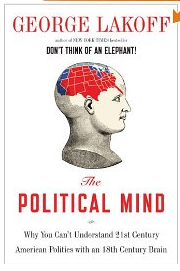
George Lakoff wrote the following in The Political Mind:
One of the most profound differences between strict and nurturant modes of thought is the area of causation. In the strict father model, there is individual responsibility and direct action operating: the father gives a directive, the child is expected to carry it out, and if not, the father punishes. Causation is direct and individual.
In the nurturant parent model, causation is sometimes direct and individual, but just as often it is systemic. Nurturance involves developing attachment, empathizing with and forming connections to others. The more absolutes are Help, Don’t Harm, Do Unto Others. … You have to function as part of a social and interpersonal system less governed by specific rules and more “felt out” in terms of how you relate to others and sense their needs and requirements [empathize].
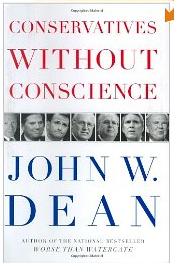
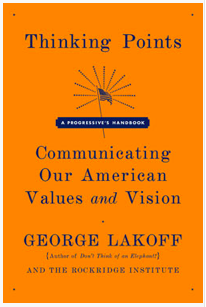
In Thinking Points, Mr. Lakoff states, “Pure conservative philosophy is the application of the strict father model – and only that model – to politics.” He also observes the “appearance of the authoritarian conservative, who applies the strict father model not just to all issues but to governing itself.” John Dean refers to these individuals as Conservatives Without Conscience (CWC).
In other words, CWCs are driven by “individual responsibility and direct action.” Mr. Lakoff restates this as their “Individual Responsibility Principle” in Thinking Points:
All of us are individually responsible for our own destiny. If you succeed, it’s because you deserve it; if you fail it’s your own fault. You’re on your own, and you should be. No coddling.
…
In surveying conservative and progressive arguments, we have noticed another important regularity. Conservatives seem to argue on the basis of direct, individual causation, while progressives tend to argue on the basis of systemic, complex causation.
The two worldviews described by Dr. Lakoff see causation differently. What evidence exists to give credence to either the strict father or the nurturant causation statements made by Professor Lakoff?
The answer is found in the many examples of success documented in Outliers by Malcolm Gladwell. In part 1 of Outliers, Gladwell reviews the different individual and systemic causes of success for several groups and individuals.
Discussed below are summaries of successful individuals and the individual and systemic factors that contributed to their success.
The Matthew Effect shows how setting cutoff dates gives individuals born closest to that date an advantage over others born later.
Championship Canadian Hockey Teams – from age 10 to professional hockey player – were determined by the following external factors:
They had to be born in Canada
They had to be born shortly after some arbitrary cutoff date – the closer the better. In this case, January first.
Their innate talent and early start got them on the “rep squad” which lead to more practice sessions and games to enhance their talents
They had a physical advantage over others when the differences between 10 year olds over a 12 month period can be significant.
Analysis of successful Canadian hockey teams shows that their members were composed of players with birthdays in the following groups:
Jan-Mar – 40%
Apr-Jun – 30%
Jul-Sep – 20%
Oct-Dec – 10%
When the researchers looked at individual months, they found more successful team members were born in January than any other month. Second in number of successful players was February and then March.
In the United States, there is a cutoff date of July 31 for baseball. Well, guess what? More major league players are born in August than any other month. Similar statistics exist for European soccer teams.
There were similar results for math testing of fourth graders. The older fourth graders scored 4 to 12% higher.
Research has also showed that not all those born in January become successful team players. Innate talent is also required. But this innate talent is given a significant boost if you are born in January in Canada and you want to play hockey. “Achievement is talent plus preparation” and those with the most preparation become champions.
One researcher said, “It’s outlandish that our arbitrary choice of cutoff dates is causing these long-lasting effects and no one seems to care about them.”
So, successful sports players had innate talent, but that talent was boosted because of when and where the player was born. This luck of the draw then lead to more chances to practice and play more games and thus boost their success and natural talent, if they had any.
Mr. Gladwell then goes on to point out that preparation for successful individuals takes about 10,000 hours. People at the top had to “work much, much harder.” Talent is there but experience is a major factor.
This experience requirement was part of the success of The Beatles, Bill Joy of Sun Microsystems, Bill Gates and many others. After reviewing details on innate talents, who they knew that provided a distinct advantage, what family they were born into and who the parents knew, and how they gained their relevant 10,000 hours of experience in a short time, Mr. Gladwell then looked at when they were born. Again a common factor about birth was part of the systemic causes for success. But again, birth is just one factor that contributed to success. “Lucky breaks” for these successful billionaires or The Beatles or star athletes “seem like the rule.”
Mr. Gladwell then listed the 75 richest people in human history based on current US dollars. Whatever the other factors, talents, or lucky breaks were for these 75 people, this list included 14 Americans that were all born within 9 years of each other. Twenty percent of this group comes from one century and one country – lucky breaks.
They were all born between 1831 and 1840. During this era railroads were starting; Wall Street was born; and industrial manufacturing started in a major way. All the economic rules were broken and remade. It really matters if you are born in a time of major transformations and get those lucky breaks.
This same kind of transformation, the personal computer age, was starting just in time for Bill Joy and BIll Gates. If you were born before 1952 and working in computers, your future was in main frames and time sharing, and you wore a black tie and white shirt. If you were born after 1958, you didn’t have time to get your 10,000 hours of computer programming experience.
Opportunity and the right experience are major systemic factors for successful people. Major opportunities occur during the right time for lucky individuals with sufficient experience plus innate talent. But it must all come together just so and at the right time for significant success to occur. But what about innate talent? Does it have limits?
The Effect of High IQ on Success:
Mr. Gladwell reviewed the value of IQ scores, a measure of innate talent, and it’s effect on success. The research shows that those with an IQ of 120 are just as likely to be successful as anyone with an IQ higher than 120.
Just after World War I, Lewis Terman, a Stanford professor, identified 1,528 individuals with an IQ of at least 140. They became known as the “Termites.” Their ages ranged from 3 to 28. A Stanford article on the termites concludes with the following:
As for what IQ scores can predict about a person’s future, Hastorf offers a middle-of-the road position: the tests are pretty good at identifying “school-bright” children, those likely to perform well in ordinary school settings, but “on the issue of what makes you school-bright, it’s obviously a combination of variables — your genetic constitution, your biological health, the motivation that your parents put into you, chance.”
Professor Terman tracked his Termites for years. When most had become adults, he reviewed the success of 730 males. He split them into three groups. The highly successful A group – top 20 percent. Ninety-eight percent of them had advanced degrees. The B group – the middle 60 percent – succeeded satisfactorily. The C group – the bottom 20 percent – were not very successful even though their IQs were 140 or more. Only a quarter of them graduated from high school and only eight earned graduate degrees. Further analysis showed the A’s were from middle and upper class families. The C’s were from the “other side of the tracks.” They all had innate talent, but the Cs lacked the other systemic factors that would foster success.
Mr. Gladwell discussed one such systemic factor that contributed to success for those with high IQs: the “motivation that your parents put into you.” “Concerted cultivation” is more relevant to success than an IQ above 120. If you can’t work with others, it doesn’t matter if your IQ is 195 – you’re not likely to be successful. Christopher Langan, discussed extensively in Outliers, is an example of someone with a high IQ but who had little success in life.
It is unfortunate, but concerted cultivation is typically missing from poor broken families, but it has nothing to do with genetics. It is cultural. The wealthy feel “entitled” to what they have. The poor learn “constraint.” The high IQ poor are less likely to be successful because they lack a “community around them that [could have] prepared them properly for the world.”
Mr. Gladwell provides ample evidence that there are systemic factors that contribute to the success of a talented individual. But there are still more …
In addition to the Matthew Effect, the requirement for 10,000 hours of experience, the luck of when and where you were born, innate talent, social connections, and having sufficient but not necessarily excessive talent – there are still the systemic factors provided by society through its government.
Here is an insightful quote from Warren Buffet (net worth around $46,000,000,000) on societal causation:
I personally think that society is responsible for a very significant percentage of what I’ve earned. If you stick me down in the middle of Bangladesh or Peru or someplace, you find out how much this talent is going to produce in the wrong kind of soil… I work in a market system that happens to reward what I do very well – disproportionately well. Mike Tyson, too. If you can knock a guy out in 10 seconds and earn $10 million for it, this world will pay a lot for that. If you can bat .360, this world will pay a lot for that. If you’re a marvelous teacher, this world won’t pay a lot for it. If you are a terrific nurse, this world will not pay a lot for it. Now, am I going to try to come up with some comparable worth system that somehow (re)distributes that. No, I don’t think you can do that. But I do think that when you’re treated enormously well by this market system, where in effect the market system showers the ability to buy goods and services on you because of some peculiar talent – maybe your adenoids are a certain way, so you can sing and everybody will pay you enormous sums to be on television or whatever – I think society has a big claim on that.
America’s government has at least two fundamental functions, protection and empowerment. Protection includes the police, firefighters, emergency services, public health, the military, and so on. Empowerment includes the infrastructure needed for business and everyday life: roads, communications systems, water supplies, public education, the banking system for loans and economic stability, the SEC for the stock market, the courts for enforcing contracts, air traffic control, support for basic science, our national parks and public buildings, and more. We are usually aware of protection. But the empowerment infrastructure, provided by taxes, is usually taken for granted, hidden, or ignored. Yet it is absolutely crucial, a fundamental truth about America and why America provides opportunity [for success].
Taxes are part of our common wealth, what we all share. Protection and empowerment serve the common good. Because of our common wealth, we are all protected and America’s empowering infrastructure is available to all. That is a fundamental America value: the common wealth should serve the common good. It benefits everyone.
Citizens are financially responsible to maintain this common wealth [by paying taxes in proportion to their gains from society]. If we shirked this responsibility, we could not maintain our roads, fund our schools, protect ourselves from military threats, enforce our laws, and so on. Equally important, we could not create prosperity [success] for ourselves, because we would have no protection of our intellectual property, no oversight of our markets, no means to enforce our contracts, no way to educate most of our children.
Gladwell details many of the specific factors that helped cause the wealth of Bill Gates and Bill Joy. Professor Lakoff explains some of the societal factors that contributed to the success of these talented and lucky citizens:
He [Bill Gates] started Microsoft as a college dropout and has become the world’s richest person. Though he has undoubtedly benefited from his unusual intelligence and business acumen, he could not have created or sustained his personal wealth without the common wealth. The legal system protected Microsoft’s intellectual property and contracts. The tax-supported financial infrastructure enabled him to access capital markets and trade his stock in a market in which investors have confidence. He built his company with many employees educated in public schools and universities. Tax-funded research helped develop computer science and the internet. Trade laws negotiated and enforced by the government protect his ability to sell his products abroad. These are but a few of the ways in which Mr. Gates’ accumulation of wealth was empowered by the common wealth and by taxation.
The research of Lakoff and Gladwell supports the progressive worldview on the causes of success – it’s much more than individual talent. Gladwell emphasizes the technical more determinant causes of success while Lakoff highlights that “the empowerment infrastructure [of our society through its government], provided by taxes, is usually taken for granted, hidden, or ignored.”
Paying taxes supports America’s infrastructure and improves the chances of success for all its citizens. This contradicts the claim of CWCs that cutting taxes, like Nixon, Reagan and Bush did, will solve our problems. Cutting taxes, especially for the rich, only increases the chances of success for the rich – like bonuses and/or continued employment for the CEOs of banks too big to fail – while it reduces the chances of success for the rest of America’s citizenry – now losing their jobs and homes.
” … to clear the paths of laudable pursuit for all; to afford all an unfettered start, and a fair chance in the race of life. “
In my previous posting, I provided a list of critical factors that compare the conservative and progressive worldviews. One of the key progressive principles mentioned several times in that posting was common wealth for the common good. As noted in that article, this principle was also mentioned in President Obama’s inaugural speech.
Unfortunately, this principle is totally absent from the strict-father, you’re-on-your-own, conservative-without-conscience, profit-first worldview because it requires empathy and responsibility to act on that empathy. This principle is also not broadly understood any more and is only documented in a few places on the internet like The Rockridge Institute. However, common wealth is critical to our democracy and here is why.
Thomas Jefferson, John Adams and Benjamin Franklin were all concerned about the accumulation of great wealth and the disparities between wealth and poverty they observed in Europe. They attributed these inequities to the European “aristocratic system of land transfers, hereditary political power, and monopoly.” Rather than concentrating wealth in a very few, our founding fathers saw common wealth as necessary for creating equality of opportunity for creating self wealth.
In the following excerpt from Wealth And Our Commonwealth, William H. Gates (father of Microsoft founder Bill Gates) and Chuck Collins, an expert on U.S. economic inequality, document our founding father’s fear of aristocracy and their ideas on taxation for creating the common wealth for the common good. This excerpt was originally posted at TomPaine.com.
The essence of the American experiment is our collective rejection of European hereditary aristocracy and grotesque inequalities of wealth. When Alexis de Tocqueville visited the United States in the mid-nineteenth century, he noted that equality of condition permeated the American spirit: “The American experiment presupposes a rejection of inherited privilege.” In the words of novelist John Dos Passos, “rejection of Europe is what America is all about.”
The nation’s founders and populace viewed excessive concentrations of wealth as incompatible with the ideals of the new nation. Revolutionary era visitors to Europe, including Thomas Jefferson, Thomas Paine, John Adams, and Ben Franklin, were aghast at the wide disparities of wealth and poverty they observed. They surmised that these great European inequalities were the result of an aristocratic system of land transfers, hereditary political power, and monopoly.
Monarchies and hereditary aristocracies mocked the republican principle of self-government. Writing in Common Sense, Thomas Paine attacked the notion of hereditary government: “To the evil of monarchy we have added that of hereditary succession; and as the first is a degradation and lessening of ourselves, so the second, claimed as a matter of right, is an insult and imposition on posterity.”
In two other articles, “Rights of Man” and “Agrarian justice,” Paine extended his contempt of inherited political power to a critique of inherited economic power. Paine proposed an inheritance tax that would fund an early version of Social Security.
The distrust of concentrated wealth was so great that, in an extreme sentiment, Ben Franklin argued “that no man ought to own more property than needed for his livelihood; the rest, by right, belonged to the state.” One could not accumulate vast wealth, in the republican worldview, simply through one’s own labors. In small-scale agrarian freeholder society, where land ownership was more widely distributed among men of European ancestry, there was a “natural distribution of wealth.” Farmers, artisans, and other workers reaped the “fruits of their own labor.”
In 1776, artisans from Philadelphia put forward a provision for inclusion in the original state constitution of Pennsylvania. They advocated for a limit on the concentration of wealth. “An enormous Proportion of Property vested in a few Individuals is dangerous to the Rights, and destructive of the Common Happiness of Mankind; and therefore any free State hath a Right by its Laws to discourage the Possession of such Property.”
The provision was narrowly rejected. But the concern about inequality and accumulated wealth was present at the formation of our nation.
Indeed, central to American republicanism was the principle of a broad and fair distribution of wealth and property. Noah Webster, writing in favor of adopting the U.S. Constitution in 1787, expressed that “a general and tolerably equal distribution of landed property is the whole basis of national freedom” and wide spread distribution of property was “the very soul of a republic.” Too much inequality was a threat to a self-governing society. Without an equitable land distribution, the founders believed, the republic would not survive.
John Adams also viewed broad land ownership as a key ingredient in maintaining a balance of political power. He was greatly influenced by seventeenth-century philosopher James Harrington, who argued that the widespread distribution of property dispersed power. Adams believed that when “economic power became concentrated in a few hands, then political power flowed to those possessors and away from the citizens, ultimately resulting in an oligarchy or tyranny.” In a 1776 letter to James Sullivan, Adams articulated his perspective that a balance in property owner ship was essential to liberty.
“The balance of power in a society, accompanies the balance of property in land. The only possible way, then, of preserving the balance of power on the side of equal liberty and public virtue, is to make the acquisition of land easy to every member of society; to make a division of land into small quantities, so that the multitude may he possessed of landed estates. If the multitude is possessed of the balance of real estate, the multitude will take care of the liberty, virtue, and interest of the multitude, in all acts of government.”
Thomas Jefferson, writing to James Madison in 1785 made the now famous statement that “the small land holders are the most precious part of a state.” He argued that legislators could not invent too many devices for subdividing property, “only taking care to let their subdivisions go hand in hand with the natural affections of the human mind.”
In the republican worldview, European aristocrats created unbalanced distributions of wealth by controlling the land through inheritance, laws of primogeniture and entail. These land tenure systems allowed land transfers only to oldest male children, maintaining hereditary concentrations of land rather than broadly distributing it. In a conscious rejection of primogeniture, Jefferson wrote:
“The descent of property of every kind therefore to all children, or to all the brothers and sisters, or other relations in equal degree, is a politic measure and a practicable one. Another means of silently lessening the inequality of property is to exempt all from taxation below a certain point, and to tax the higher portions of property in geometrical progression as they rise.”
The revolutionaries believed in equitability, a notion of relative equality and fairness, rather than rigid equality. Revolutionary writers and orators underscored that American society would have modest inequalities. “The utopian schemes of leveling, and a community of goods,” wrote Sam Adams, “are as visionary and impracticable, as those which vest all property in the Crown.” Rigid equality, according to Sam Adams, would be “arbitrary, despotic, and in our government unconstitutional.” Minor inequalities would exist as the result of differences in individual talent, effort, and modest variations in property ownership.
This equitability translated into a culture that was antiaristocratic in sentiment. To be labeled an aristocrat or to be accused of advocating for “aristocratic policies” was the ultimate political slander in revolutionary America. For instance, John Adams through much of his later years had to fight the whispers that he had “monarchist sympathies,” having spent so many years consorting with royalty in France and England.
The founders celebrated the exceptionalism of the American experiment and heartily rejected aristocratic politics and economic policy. “The economic agenda for a republic became clear,” writes James Huston. “Enact the opposite of aristocratic legislation.”
What made the new nation unique was its relative equality. Noah Webster exuded confidence in the justness of the American system: “Here the equalizing genius of the laws distributes property to every citizen.” In other words, no rent to an absentee landlord or land ownership monopolies.
In their enthusiasm, the revolutionaries glossed over some of the enormous inequalities that existed in colonial society, the most obvious of which was the existence of slavery. “American society was not egalitarian and some individuals possessed impressive amounts of wealth,” writes Huston. “An elite did exist, and much of its property had come from political favoritism, inheritance, or family connections.” At the same time, their prescriptions for addressing this inequality were overly simplistic. For instance, the founders thought that eliminating the aristocratic land laws of entails and primogeniture would institutionalize relative equality. John Adams and Thomas Jefferson wrote confidently that America’s land tenure system encouraged subdivision and a broader distribution of land ownership, preventing aristocratic concentrations of ownership. Our nation’s founders were blind to some of the inequalities in their midst. But our national creed — with its aspiration to greater equality and suspicion of accumulated wealth and power — was forged at the time of our nation’s independence.
This “suspicion of accumulated wealth and power” was a significant cause for our revolution against Great Britain. The majority of our earliest citizens rejected aristocracy in favor of democracy and wanted taxation to limit the accumulation of wealth. However, this limitation must be turned to the common good of the new nation by equality of opportunity.
Now, over two hundred and thirty years later, we are in the midst of another struggle over the concentration of excessive wealth and power. This struggle has evolved slowly by reducing the funding of our common wealth for the common good. It started in 1963 when our top personal tax rate of 91 percent, which had existed since the end of World War II, was reduced to 70 percent. In 1982 the top rate was dropped another 20 points to 50 percent. Since 1987, the top tax rate has varied between 39.6 and 28 percent.
Since 1963, we have been creating a new conservative-without-conscience (CWC) aristocracy which, as our forefathers feared, is a threat to our democracy. We have been conned into letting this happen by the CWCs who have been telling us for years that taxes are not good; government will not make proper use of it; only the free market works in the best interest of the nation’s citizens; if you are disciplined, it’s OK to be extremely rich; and there are those among us who do not deserve a helping hand because they are not moral.
This growing aristocracy is using their excessive wealth and power to pay tens of thousands of lobbyists to get their taxes reduced and their powers increased further. Looking back at our early history, I suggest that today’s CWCs represent the new American Empire. They are at least leftover “Loyalists” from our revolution for independence.
As the CWCs have grown their aristocracy, our infrastructure, our government and the rest of us have suffered. Our bridges and highways are decaying. Our schools are failing our children and only the very rich get a good education. Our air and water are poisoned. Our national resources are being pillaged for profit. Our right to vote is under threat to help keep the CWC minority in control. Our heath care is failing to care for all but the very rich CWCs and our climate may turn on us all like never before while the CWCs speed around in their luxury SUVs.
What all this means is that we are transferring the funding of our nation’s common wealth back to the Paris Hiltons, Rupert Murdochs and other powerful CWCs of the world through one tax reduction after another. Yes, you might get something back to help pay your bills that are piling up, but the CWCs get much much more and will buy another yacht or congressman with their spare change. The rest of the nation, on the other hand, struggles to get their kids a good education, find affordable transportation to get to work, keep themselves and their children healthy and wonder if their future is doomed to climatic cataclysm. In the mean while, the mega-rich continue to shop extravagantly, collect unreasonable bonuses and take corporate welfare while avoiding proportionately replenishing our common wealth through progressively higher taxation.
Common wealth is not what CWCs believe in. CWCs are moral by virtue of their disciplined nature and are thus more deserving of wealth and power than other citizens. Their individualistic, self disciplined, moralistic, authoritarian, direct-causation worldview means all the money they earn is theirs. They earned it all by themselves.
CWCs don’t recognize that the nations’ infrastructure helped create their wealth. Since it didn’t help them, there is no need for them to pay to maintain it. Thus, they believe that taxes to fund the common wealth are wrong regardless of its contribution to their self wealth.
In addition to our vanishing common wealth, our democratic government is disappearing courtesy of the CWC aristocracy. In the CWC worldview, the Government interferes with creating wealth and steals self wealth just to give it to undisciplined immoral slackers (Remember, direct causation blinds the CWCs to the intermediate common wealth that is managed by the democratic government to promote equal opportunity for all). So, to minimize government, stop funding it. Specifically, stop taxing the CWCs that gain the most from the infrastructure which was built from our common wealth. In addition, redirect what common wealth is left to privatize government functions and help maximize the CWC aristocracy.
Privatization is fine as long as the government responsibility to protect and empower is not part of the deal. Privatizing means there is no accountability to the voters and profit takes precedence over protecting and empowering citizens. Our democratic government is responsible for protecting and empowering its citizens. The free market is responsible for making profit and profit will trump protecting and empowering citizens every time.
Our democratic government must protect and empower all of us. Protection includes the police, firefighters, emergency services, public health, the military, and so on. Empowerment includes the infrastructure needed for business and everyday life: roads, communications systems, water supplies, public education, the banking system for loans and economic stability, the SEC for the stock market, the courts for enforcing contracts, air traffic control, support for basic science, our national parks and public buildings, and more.
Building the new CWC aristocracy is wrong. It robs us of our common wealth, redirects our protection toward war and away from civil rights, prevents building and maintaining our nation’s infrastructure and eliminates equal opportunity.
Many of us believe, like our American revolutionary heroes mentioned at the beginning of this post, that we need to be responsible for ourselves and others and do what is necessary to keep and continually improve our democracy. Our innate empathy tells us that as parents we must protect and empower our children and, likewise, our government must protect and empower its’ citizens. To do that, we must proportionally fund the nation’s common wealth for the sake of the nation’s common good.
The progressive worldview closely matches our Founding Fathers. Progressives support Paine’s inheritance tax and Jefferson’s progressive tax. We must fund the common wealth for the common good. We must fund the common wealth so the government can protect and empower we the people. We must fund the common wealth to promote equality of opportunity for creating self wealth which will replenish the common wealth. We must fund the common wealth to promote our American democracy and inhibit the new CWC aristocracy.
The CWC worldview is wrong. We can’t have a government to protect and empower us (infrastructure) while we let the very rich become the mega rich. Eventually, most of us will pay a very high price.
The Greatest Generation paid for World War II with income tax rates as high as 94 percent. All we were asked to do for Bush’s war was shop.
It’s time we pay our own way. It’s time to stop asking others (China, Japan, etc.) to pay our bills. It’s time for the very rich and corporations to contribute much more to our common wealth so they don’t succeed in turning our democracy into an aristocracy.
I close with a quote from another great American, an American that was not an aristocrat, Abraham Lincoln.
“This is essentially a people’s contest. On the side of the Union it is a struggle for maintaining in the world that form and substance of government whose leading object is to elevate the condition of men — to lift artificial weights from their shoulders; to clear the paths of laudable pursuit for all; to afford all an unfettered start, and a fair chance in the race of life. Yielding to partial and temporary departures, from necessity, this is the leading object of the government for whose existence we contend.” – Abraham Lincoln Address to Congress (4 July 1861)